
Your Purchase Helps
shelter pets in need
Each order helps pets in need
shelter pets in need
Each order helps pets in need

A dog that eats a balanced diet does not need a multivitamin, according to the veterinary nutritionists at Tufts University's Cummings School of Veterinary Medicine, and extra vitamins can do harm. The seven Healthy Breeds products below are for the dog whose vet has found a reason to add one, and for the dog parent who wants to know what each chew or tablet contains before that vet visit.
Lisa Freeman, DVM, PhD, DACVIM (Nutrition), wrote for Tufts: "Unless a pet is eating a nutritionally unbalanced diet, multivitamins are not needed. In fact, giving vitamin or mineral supplements to a pet eating a balanced diet may put them at risk for toxicity!" She adds: "Complete and balanced pet foods are made to give your pet just the right amount of nutrients and adding more can actually be harmful."
Her Tufts colleague Cailin Heinze, VMD, MS, DACVIM (Nutrition), says the same about store-bought food: "If your pet is eating a commercial pet food, they should not need any vitamin or mineral supplements unless a specific health issue has been identified that might benefit from higher amounts." A home-cooked diet is a different case. Heinze writes that a standard supplement "is not going to be meeting their nutrient needs" for a dog on one, and advises working with a board-certified nutritionist to design the diet.
Vitamin D shows how an excess goes wrong. The FDA's Center for Veterinary Medicine says vitamin D is stored in fat tissue and the liver, and that "Excessive vitamin D can lead to kidney failure and even death." Signs include vomiting, little appetite, more drinking and urinating, heavy drooling, and weight loss. The FDA says: "If you suspect your dog is showing signs of vitamin D toxicity, take him or her to a veterinarian immediately."
Joint and fish oil products come up next to vitamins. Freeman writes that glucosamine and chondroitin supplements, "if they are of good quality, may have modest benefits in some animals with arthritis," and that fish oil "may be beneficial for pets with certain medical conditions, such as heart disease, kidney disease, and cancer." She continues: "However, even these common supplements have potential side effects and are not right for every dog and cat with these conditions." If joints are the concern, our hip and joint supplement guide for German Shepherds covers hip dysplasia and the products sold for it. If skin is the concern, our guide to dog food for German Shepherds with skin allergies covers skin irritations from the diet side.
Freeman's first step applies to every product here: "The first step is to talk to your veterinarian about whether supplements are appropriate for your pet." A dog with ongoing stomach trouble, limping, or a coat that has changed needs a vet visit before any supplement is added.
This table shows the form and count of each product and what its listing or the maker's page names. Check the price and stock on each listing, because both change.
| Product | Form and count | What the listing or maker names |
|---|---|---|
| Multi-Vitamin Soft Chews | Soft chews, 60 count | Vitamins, minerals, and antioxidants |
| All in One Multivitamin Soft Chew | Soft chews, 90 count | Vitamins and minerals, essential fatty acids, glucosamine, chondroitin, and probiotics |
| Multi-Tabs Plus | Chewable tablets, 365 count | Vitamins and minerals, with liver powder in the ingredient list |
| All in One Multivitamin Soft Chew | Soft chews, 120 count | Chondroitin sulfate and dried Bacillus coagulans in the ingredient list |
| Puppy Multi-Vitamin | Chewable tablets, 60 count | Made for dogs under 1 year of age |
| Salmon Oil Soft Chews | Soft chews, 90 count | Salmon oil, for skin and coat support |
| Multi-Vitamin Soft Chew for Dogs | Soft chews, 180 count | Vitamins and minerals, with dried chicken liver first in the ingredient list |

Healthy Breeds sells this as a 60 count tub of heart-shaped soft chews. The listing calls it a daily nutritional supplement with a blend of vitamins, minerals, and antioxidants, and says it is made in FDA, USDA, and FSIS regulated manufacturing facilities.
Pros
Cons
The label also says "If giving more than 1 chew daily, divide between AM and PM." Ask your vet whether your dog's food leaves a gap before you buy it.

The listing titles this the Healthy Breeds German Shepherd All in One Multivitamin Soft Chew, 90 count, and describes a 4-in-1 chew: a multivitamin with vitamins A, B, C, D, E, and K and other minerals, essential fatty acids for skin and coat, glucosamine and chondroitin for joints, and probiotics. The flavor is chicken, and the listing says it is made in FDA, USDA, and FSIS regulated facilities.
Pros
Cons
For probiotic products on their own, see our guide to the best probiotics for German Shepherds. Check this chew's ingredient list against any food reactions your dog has had.

Healthy Breeds recommends Multi-Tabs Plus as a daily supplement for "active, older and working dogs." The tablets are chewable, and the maker says to "Give by hand just prior to feeding, or crumble and mix with food." The ingredient list includes liver powder, molasses, and a long run of vitamins and minerals.
Pros
Cons
Check the instructions on the label for your dog's weight, and ask your vet whether your dog needs a multivitamin at all.

The listing title is Healthy Breeds German Shepherd All in One Multivitamin Soft Chew, 120 count, and the label front reads Joint, Probiotic, Omega. The ingredient list on the maker's page includes chondroitin sulfate, flaxseed, dried shellfish digest, and dried Bacillus coagulans fermentation product.
Pros
Cons
The calorie figure lets you count the chews with the day's food, and the feeding chart is on the label. The overlap warning from Tufts, quoted above, applies to any joint product given alongside this chew.
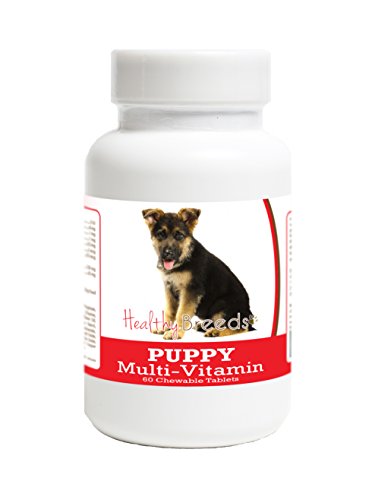
The listing title is Healthy Breeds German Shepherd Puppy Dog Multivitamin Tablet, 60 count. The maker's page says "Recommended for dogs under 1 year of age" and describes "liver-flavored chewable tablets."
Pros
Cons
The AKC says too much calcium can cause skeletal problems in large-breed puppies. A German Shepherd puppy grows into a large dog, so ask the vet before you start these tablets.

The listing title is Healthy Breeds German Shepherd Salmon Oil Soft Chews, 90 count. Salmon oil is in the ingredient list, and the maker's page says the product "is intended for intermittent or supplemental feeding."
Pros
Cons
For liquid salmon oils, see our guide to the best salmon oil for German Shepherds.

The listing title is Healthy Breeds German Shepherd Multivitamin Soft Chew for Dogs, 180 count. The maker's page lists dried chicken liver, cane molasses, dicalcium phosphate, glycerine, and soybean oil first, and says the chews are recommended for dogs of all breeds, sizes, ages, and activity levels.
Pros
Cons
Read the ingredient list against any diet your vet has set for your dog.
Want to know more about giving your pet a nutritious diet? Check out the best food for German Shepherd puppies next!
The AKC says: "Dogs fed an appropriate commercial diet should not require vitamin supplements unless recommended otherwise by a veterinarian." Its article on vitamins and minerals for dogs goes through vitamins A, B, C, D, E, and K and choline, and says dogs need them in different amounts than people do. It also says human vitamins "may even contain additives that are harmful to dogs."
Heinze of Tufts tells dog parents to "Compare the nutrients between the products you are using and look for nutrients that are present in more than one product or have a lower threshold for toxicity such as vitamin A, vitamin D, and selenium". The AKC says too much vitamin A "can cause dehydration, joint pain, and can even harm your dog's blood vessels." Heinze adds: "If you are using more than 2-3 dietary supplements on top of a commercial pet food, you should carefully consider the reasons and data behind the use of the supplements."
Freeman of Tufts writes: "Unlike drugs, dietary supplements do not require the US Food and Drug Administration (FDA) to review product effectiveness, safety, or quality prior to marketing."
When browsing, always check the purity and source of the vitamins. Certifications and approvals from veterinary associations - or standards used in preclinical labs (think reagents from companies like Selleckchem) - can be indicators of a high-quality product. Equally important is checking that there are no harmful additives or fillers.
The product should provide a clear dosing chart. It's essential to avoid over-supplementation, which can be just as detrimental as a deficiency.
The amounts on this page are quoted from product labels and apply to those products only. Ask your vet for the amount that fits your dog and the food it eats.
The seven products here are soft chews and chewable tablets. The 365 count tablets list vitamins and minerals only, while the 90 and 120 count soft chews also list joint and probiotic ingredients, and the salmon oil chews list fish oil.
READ NEXT: Homemade Food for German Shepherds: Nutritious DIY Meal Ideas
Leave a comment