
Your Purchase Helps
shelter pets in need
Each order helps pets in need
shelter pets in need
Each order helps pets in need

Ask your vet before you buy any of these. The American Kennel Club says hip dysplasia is "especially common in larger dogs, like the Great Dane, Saint Bernard, Labrador Retriever, and German Shepherd Dog," and it says of joint supplements: "While research is still limited, these supplements may help reduce symptoms of hip dysplasia." The seven chews below are described from their Amazon listings and label photos, and the buying guide shows what veterinary and research sources say about each ingredient, including where they disagree.
For walks, see our guide to Harnesses. If you also give vitamins, read our vitamins for German Shepherds guide first, because some joint chews list more than one active ingredient.
All seven picks are chews. Follow the serving on each label and your vet's instructions. Maker claims below are quoted or attributed to the maker, and none of them is a promise of what the product will do for your dog.

Healthy Breeds sells this as a soft chew, 50 to a tub, and the label shows a German Shepherd. The listing calls Z Flex Max the medium and large dog formula and names "Glucosamine, Chondroitin, Perna Canaliculus, and Omega-3 Fatty Acids" as the blend.
Pros
Cons

This second Healthy Breeds product is a 120 count soft chew with a bacon flavor. The listing names glucosamine, chondroitin, organic turmeric, and MSM, calls the chews gluten free and grain free, and says they are made in the USA.
Pros
Cons

VetIQ sells these as soft chews with a chicken flavor, 180 to a bag, with MSM and krill. The listing says the chews are NASC-certified, which is the maker's claim, so look for the NASC seal on the bag itself.
Pros
Cons
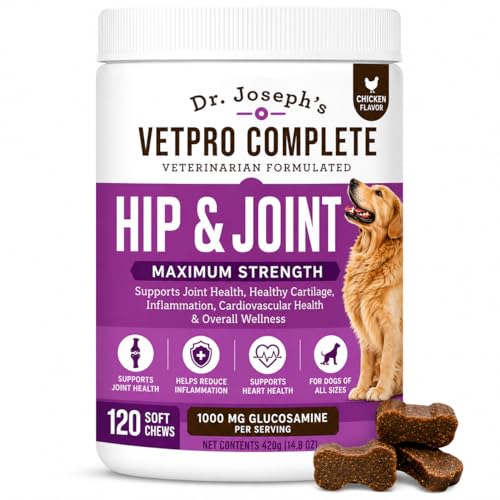
The listing for this 120 count tub names glucosamine, chondroitin, MSM, turmeric, and omega-3s. It describes the chews as "Intentionally firm, dry chews" and says they are made in the USA in a GMP-certified facility.
Pros
Cons
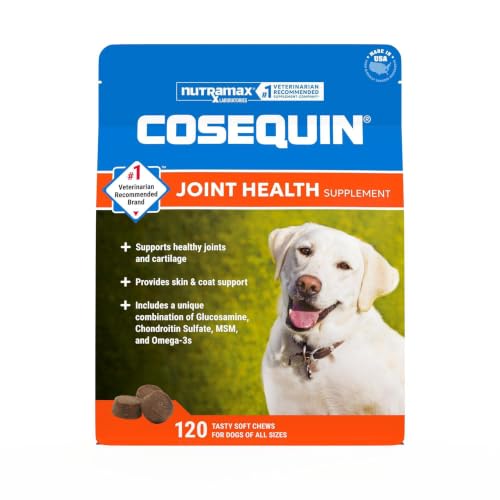
Nutramax lists glucosamine hydrochloride, sodium chondroitin sulfate, MSM, and omega-3 in each of these 120 soft chews. The listing says the product is "For Any Breed or Size," so it is not made for large dogs in particular.
Pros
Cons
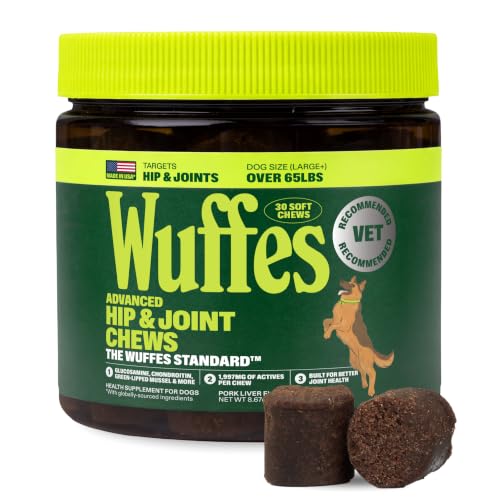
The title of this 30 count pork chew lists glucosamine, chondroitin, MSM, green-lipped mussel, hyaluronic acid, and omega-3s. The label photo reads "Dog size (large+) over 65 lbs" for the large dog size.
Pros
Cons

Doggie Dailies sells a 225 count tub with a chicken flavor for all breeds. The listing names MSM, CoQ10, omegas, turmeric, and yucca, gives the dose in 15 pound steps, and says the chews carry the NASC Seal.
Pros
Cons
The AKC lists "Difficulty or reluctance rising, jumping, running, or climbing stairs" as a sign of hip dysplasia. The OFA says: "No one can predict when or even if a dysplastic dog will start showing clinical signs of lameness due to pain." It also says "The key is weight control and exercise," and that the severity of the disease can be affected by environmental factors such as caloric intake or level of exercise.
For puppies, VCA says "A study of German shepherds found that overweight puppies were almost twice as likely to develop hip dysplasia as their normal-weight counterparts." The OFA says "prior to initiating any therapy, the attending veterinarian should be consulted with a complete medical history and physical examination." For rest, the OFA says "a well-padded and warm bed will help alleviate some of the pain associated with osteoarthritis," and our guide to dog beds for German Shepherds covers the options.
When reading labels, let's keep our eyes peeled for a few key ingredients that promote joint health:
Several of the chews above list Omega-3 fatty acids among their ingredients. The Kennel Club in the UK says: "Omega-3 is described as an anti-inflammatory supplement, being advertised as beneficial for dogs' skin and coat while improving mobility by supporting stiff, aching joints." It adds: "Always speak to your vet before giving your dog any supplements".
| Ingredient | Source | What it says |
|---|---|---|
| Glucosamine and chondroitin | VCA Animal Hospitals | "Some small research studies and numerous anecdotal case histories suggest these products are beneficial, and they appear to be free of side effects." |
| Glucosamine and chondroitin | Tufts Cummings School | "if they are of good quality, may have modest benefits in some animals with arthritis." |
| Glucosamine and chondroitin | Barbeau-Gregoire et al., a review in the International Journal of Molecular Sciences | "a very marked non-effect of chondroitin-glucosamine nutraceuticals" |
| Glucosamine and chondroitin | Aragon et al., a review in JAVMA | "A moderate level of comfort exists for" a combination of chondroitin sulfate, glucosamine hydrochloride, and manganese ascorbate. |
| Omega-3 fatty acids | VCA Animal Hospitals | "proven to decrease pain in dogs with arthritis" |
| Omega-3 fatty acids | Vandeweerd et al., a review in the Journal of Veterinary Internal Medicine | "The evidence of efficacy of nutraceuticals is poor, with the exception of diets supplemented with omega-3 fatty acids in dogs." |
| Green-lipped mussel | VCA Animal Hospitals | "has also shown promising evidence to help dogs with DJD" |
| Green-lipped mussel | Aragon et al., a review in JAVMA | Listed among the treatments with "A moderate level of comfort" in the review. |
The sources do not agree. VCA's page on nutraceuticals says "Despite the popularity of glucosamine/chondroitin supplements, research to support definitive benefits has yet to be available." Barbeau-Gregoire and colleagues say their results lead them to recommend that glucosamine and chondroitin "should no longer be recommended for pain management in canine and feline osteoarthritis."
All seven picks are chews. The AKC says a veterinarian "will most likely recommend a chewable supplement with a veterinarian-grade dose of glucosamine and chondroitin." VCA says EPA "can also be delivered as a supplement, either in liquid or capsule form," and our guide to salmon oil for German Shepherds covers the liquid route. VCA says "some can be harmful to your dog, and some may interact with other medications your dog is taking."
The National Animal Supplement Council says: "Look for the yellow Quality Seal on supplements for dogs, cats and horses to know you're buying from responsible suppliers that pass a comprehensive third-party audit and maintain ongoing compliance with rigorous NASC quality requirements." One of its criteria is to "Submit to random product testing by an independent lab to ensure products meet label claim." The VetIQ and Doggie Dailies listings say their chews are NASC-certified or carry the seal, and that is the makers' claim.
VCA says "Since supplements are not highly regulated, some may not contain the labeled amount of ingredients and there may be quality differences between products made by different manufacturers. Your veterinarian may recommend a trusted brand." Tufts adds: "Unlike drugs, dietary supplements do not require the US Food and Drug Administration (FDA) to review product effectiveness, safety, or quality prior to marketing."
Remember, it's always a wise move to consult with a veterinarian to make sure we’re selecting the best supplement for our German Shepherd's unique needs.
None of the sources names one best product. VCA says "Most dogs with hip dysplasia should receive veterinary-approved joint supplements, including omega-3 fatty acid nutritional supplements." The Barbeau-Gregoire review found an "evident clinical analgesic efficacy for omega-3-enriched diets, omega-3 supplements and cannabidiol (to a lesser degree)." Your vet can match a product and a serving to your dog.
The Wuffes listing names glucosamine, chondroitin, MSM, green-lipped mussel, hyaluronic acid, and omega-3s, and the label photo gives a large dog size of over 65 pounds. None of the sources used here tested this product. Tufts says "If your veterinarian recommends a supplement, be sure to also ask for specific recommendations on dose and brand."
Ask your vet first. The Kennel Club says "Always speak to your vet before giving your dog any supplements". The AKC says large-breed puppy food can "help prevent excessive growth, which can lead to skeletal disorders such as hip dysplasia," and VCA says "these puppies should be kept at a normal, lean weight during growth, not overfed or encouraged to grow big."
The OFA says: "Oral disease-modifying osteoarthritis agents known as nutraceuticals are now on the market. These drugs take approximately one month to reach therapeutic levels in the bloodstream."
VCA says "Good joint support diets are rich in the omega-3 fatty acid eicosapentaenoic acid (EPA)." Our guide to dog food for German Shepherds covers food options, and your vet can say whether a joint diet fits your dog.
For rewards between meals, see our list of dog treats for German Shepherds.
READ NEXT: Best Dog Houses for German Shepherds: Cozy Havens for Your Loyal Companion
Leave a comment