
Your Purchase Helps
shelter pets in need
Each order helps pets in need
shelter pets in need
Each order helps pets in need

Pick a dry food whose maker states that it is complete and balanced for adult dogs, then let your dog’s body condition and your vet decide whether it stays. The AKC lists adult male German Shepherds at 65 to 90 pounds and females at 50 to 70 pounds, so a bag goes fast and the food has to work for a big dog. The seven foods below all carry an adult maintenance statement or a complete and balanced statement from the maker’s own page. A German Shepherd puppy needs a growth food instead, so that guide is separate.
Two more guides go deeper on one problem each. For loose stools or a touchy stomach, see our guide to food for German Shepherds with sensitive stomachs. If itchy skin is the problem, a vet visit comes first, and the page on a sensitive skin and stomach formula picks up after that.
The FDA says: “If this statement includes the phrase ‘complete and balanced,’ then the product is intended to be fed as a pet’s sole diet and should be nutritionally balanced.” To carry that phrase, a dog food must meet an AAFCO nutrient profile or pass a feeding trial that uses AAFCO procedures. AAFCO has one profile for growth and reproduction and one for adult maintenance, and the FDA adds that “Pet food made for adult dogs and cats contains lower levels of some nutrients, eliminating unnecessary excesses.”
The WSAVA, the global small animal veterinary association, says that “Diets labeled ‘for all life-stages’ are formulated for reproduction and growth.” It also says that marketing words such as ‘holistic’ or ‘premium’ are “of little practical value for nutritional assessment.” The FDA says the same about outside praise: “Endorsements and seals of approval from other organizations are not assurances of nutritional adequacy and may be misleading.”
The WSAVA asks one more thing of the bag: “Having access to accurate pet food caloric content can help prevent unintended overfeeding.” Calories per cup differ from food to food, so a cup of one food is not a cup of another.
Check price and stock on each listing. Every food here is a dry food for adult dogs.
| Food | Maker statement |
|---|---|
| Royal Canin German Shepherd Adult | AAFCO Dog Food Nutrient Profiles, maintenance |
| Hill’s Science Diet Large Breed Adult | Feeding tests using AAFCO procedures, adult maintenance |
| IAMS Proactive Health Large Breed | “100% complete and balanced” |
| Purina Pro Plan Sensitive Skin & Stomach Large Breed | “100 percent complete and balanced” for large adult dogs |
| Diamond Naturals Large Breed Adult | AAFCO Dog Food Nutrient Profiles, maintenance |
| Taste of the Wild High Prairie | AAFCO Dog Food Nutrient Profiles, maintenance |
| VICTOR Grain Free Hero Canine | AAFCO Dog Food Nutrient Profiles, adult maintenance |
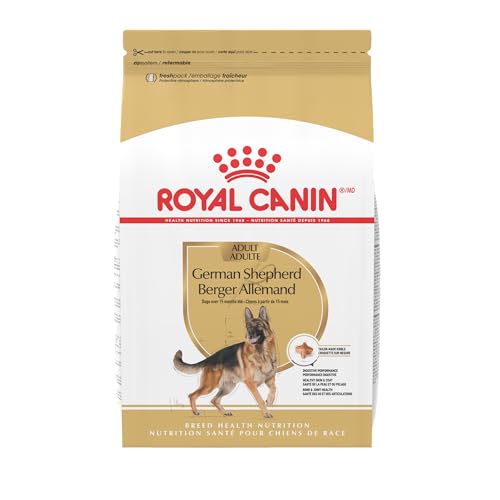
This is the one food here made for the breed. Royal Canin’s page says it “is designed to meet the nutritional needs of purebred German Shepherds 15 months and older,” and that the kibble shape and texture are “specially designed for your German Shepherd’s long, strong muzzle and teeth, encouraging them to chew.” Its statement reads: “formulated to meet the nutritional levels established by the AAFCO Dog Food Nutrient Profiles for maintenance.”
The guaranteed analysis lists a minimum of 22.0% crude protein and 17.0% crude fat, and the first ingredients are brewers rice, chicken by-product meal, and brown rice. It also lists glucosamine and chondroitin sulfate, each marked as not recognized as an essential nutrient by the AAFCO profiles. The page gives 321 kilocalories per cup, and its feeding chart says a 57 pound dog on low activity gets 3 1/4 cups a day. Use that chart as a start and check it against your dog’s own weight.

Hill’s page says: “Animal feeding tests using AAFCO procedures substantiate that Hill’s Science Diet Adult Large Breed Chicken & Barley Recipe Dog Food provides complete and balanced nutrition for maintenance of adult dogs.” The page recommends it for large breed adults 1 to 5 years old with an ideal weight of 55 to 110 pounds, and it lists large breed puppies under “Not recommended for.”
Chicken is the first ingredient, followed by cracked pearled barley, brown rice, and brewers rice. The nutrient table gives glucosamine at 607 ppm and chondroitin sulfate at 1049 ppm. Whole grain wheat and whole grain corn are on the list too.

This is a grain free food built on roasted bison and roasted venison, and its page lists a minimum of 32.0% crude protein and 0.12% taurine. The statement reads: “formulated to meet the nutritional levels established by the AAFCO Dog Food Nutrient Profiles for maintenance.” Ask your vet whether your dog needs anything extra, such as a fish oil supplement.
Read the grain free section below before you choose it. The FDA has been investigating a possible link between diets like this one and a heart disease in dogs, and that makes this the pick to talk over with your vet first.

IAMS calls this large breed adult recipe “a 100% complete and balanced” dry food with real chicken as the first ingredient and protein from chicken and egg. The bag you buy carries the guaranteed analysis with the exact nutrient levels.

Purina describes this salmon and rice formula as having “real salmon as the first ingredient,” “glucosamine and EPA, an omega-3 fatty acid, for joint health and mobility,” and “100 percent complete and balanced nutrition for large adult dogs.” It also lists oat meal and a natural prebiotic fiber. The page gives 404 kilocalories per cup, compared with 321 for the Royal Canin above.

VICTOR’s page lists 33.0% minimum crude protein, 16.0% minimum crude fat, and glucosamine at a minimum of 800 mg/kg. It lists the recipe as “Ideal for highly active adult dogs that are susceptible to joint issues later in life,” and the statement reads: “formulated to meet the nutritional levels established by the AAFCO Dog Food Nutrient Profiles for Adult Maintenance.” It is a grain free recipe, so the FDA section below applies to it as well.

Lamb meal is the first ingredient, followed by whole grain brown rice, cracked pearled barley, and oatmeal. Diamond’s page lists a minimum of 22.0% crude protein and says the formula has “Glucosamine and chondroitin for joints” and K9 Strain Probiotics. The statement reads: “formulated to meet the nutritional levels established by the AAFCO Dog Food Nutrient Profiles for maintenance.”
Two foods above are grain free. The FDA says it began investigating “reports of canine dilated cardiomyopathy (DCM) in dogs eating certain pet foods, many labeled as ‘grain-free,’ which contained a high proportion of peas, lentils, other legume seeds (pulses), and/or potatoes in various forms”. It also says that the potential association between diet and DCM “is a complex scientific issue that may involve multiple factors.” The FDA urges pet parents “to work with their veterinarians, who may consult a board-certified veterinary nutritionist, to obtain the most appropriate dietary advice for their pet’s specific needs prior to making diet changes.”
The FDA lists the signs to watch for: “decreased energy, cough, difficulty breathing and episodes of collapse.” If you see them, call your vet as soon as possible.
The feeding chart on the bag is a starting point, and your dog’s body is the check. The WSAVA body condition score chart describes an ideal score of 5 as “Ribs palpable without excess fat covering.” A score of 7 reads “Ribs palpable with difficulty; heavy fat cover.” Your vet can tell you where your dog sits on that scale and how much your dog should eat.
Ask your vet about hip and joint supplements for German Shepherds before adding one to a complete and balanced food.
Tufts University’s veterinary nutrition team recommends “gradually mixing an increasing amount of the new food into to the old diet for over the course of at least one week to allow your pet’s digestive tract the time to adjust.” Tufts says that “some soft stool can occur during a diet change.” It also says: “If your pet has continued vomiting, liquid diarrhea, or appears painful or lethargic, call your veterinarian.” If your dog turns down meals after a switch, our guide to food for picky German Shepherds covers that.
A complete and balanced food is meant to be a dog’s sole diet, and the FDA says treats and snacks “are often not complete and balanced.” For chews between meals, see our guide to the best bones for German Shepherds.
Royal Canin’s page describes its German Shepherd Adult food as designed for purebred German Shepherds 15 months and older. The other six foods are not made for the breed, and each carries its own adult statement. Ask your vet whether a breed food makes sense for your dog.
The FDA says a food that says “complete and balanced” is intended to be a pet’s sole diet. If you mix foods, the WSAVA says: “Where it is not provided on the label it should be available by contacting the manufacturer or calculating from label nutrient analysis.” Add up the calories of both foods and ask your vet for your dog’s daily need.
Food details come from each product's Amazon listing and the maker's page.
Leave a comment