
Your Purchase Helps
shelter pets in need
Each order helps pets in need
shelter pets in need
Each order helps pets in need

A large hamster cage is one that gives a Syrian hamster at least 40 inches of floor length, 20 inches of width, and 16 inches of height. That is the minimum PetMD gives in its Syrian hamster care sheet, and it says the larger the better. The PDSA, a UK pet charity, says most hamster cages sold in shops are not big enough to meet a hamster’s most basic needs. So a cage that looks big in a store aisle can still fall short.
Every cage below is 40 inches long or more, with a floor at least 20 inches wide. Hamsters need ample space to run, dig, and nest, and the floor is where most of that happens. Once the home is sorted, pair it with the best hamster food for your hamster’s size and age.
PetMD puts the Syrian minimum at 40 inches long, 20 wide, and 16 high. For dwarf hamsters its minimum is 24 by 12 by 12 inches, and it says to always provide the largest habitat possible. Neither number is a target. Both are the floor you start from.
The PDSA says there is not a lot of evidence for exactly how big a hamster cage should be. It notes that the Veterinary Association for Animal Welfare in Germany states a minimum cage size of 100 by 50 centimeters, which is about 39 by 20 inches, and that bigger is always better. If you are weighing cage sizes, the PDSA’s page on an ideal hamster home is worth reading in full.
Height matters less than floor space. The PDSA says single-level, larger cages tend to be better than multi-level, tall cages, as hamsters have poor eyesight and can easily fall from heights. The cages here are tall enough for deep bedding. PetMD recommends at least 6 to 10 inches of compressed paper-based bedding when the enclosure size allows it, and the PDSA says bedding should be no less than 25 centimeters, or 10 inches, deep.
What a hamster needs beyond the cage, from bedding to the wheel, is covered in our guide to what a hamster costs to keep.

All six are metal-framed enclosures with clear acrylic or plexiglass sides. Wooden cages are left out on purpose, and the reasons are in the buying guide below. The sizes, frame materials, and doors below come from each Amazon listing. Listings change, so check the size and the price on the listing before you buy.
| Cage | Listing size | Frame, sides, doors |
|---|---|---|
| BUCATSTATE 3.0 | 47 x 23.6 x 25.5 | Metal, acrylic, 3 doors |
| VEVOR 47 inch | 47.2 x 23.6 x 25.4 | Aluminum, acrylic, top and front |
| MUNNAR | 40.5 x 20.4 x 22 | Carbon steel, acrylic, top and front |
| BORISI | 40.5 x 22 x 20.8 | Metal, plexiglass, front door |
| ALLOYNIX | 40 x 20 x 20 | Metal, clear sides, top opening |
| JIWINNER 40 inch | 40 x 20 x 20 | Aluminum, acrylic, hinged top |

This is the biggest floor here at 47 by 23.6 inches, and it stands 25.5 inches tall. The listing says the base holds bedding up to 11 inches deep, which is above both the PetMD and PDSA bedding depths. It lists a chew-proof metal frame, thickened clear acrylic, three doors, and a front door with six switch clasps. It also says the cage slides together in about 30 minutes and has a bottom with no seams.
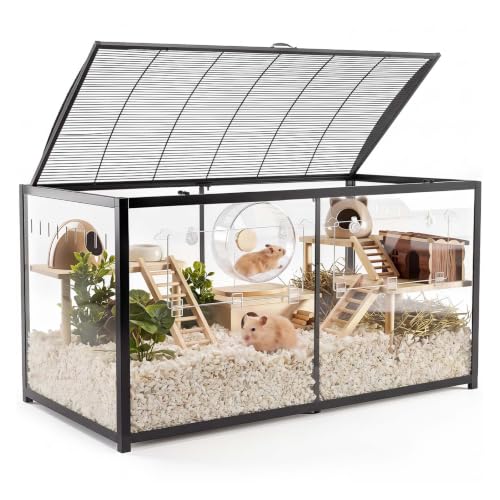
The VEVOR measures 47.2 by 23.6 by 25.4 inches, which the listing gives as 7.7 square feet. The frame is aluminum alloy with acrylic panels and a steel wire mesh top, and the listing describes ventilation on three sides. You can open the top lid or slide the front acrylic panel out, and the front panel locks with a wing-style rotating latch.

The listing gives outside measurements of 40.5 x 20.4 x 22 inches and interior measurements of 103 x 52 x 56 centimeters, so it clears the PetMD Syrian minimum by a small margin. It lists a carbon steel frame with acrylic panels, a top door and a front door, and triple latches on the front door. The base is described as leak-proof with no seams. Assembly uses 8 screws plus adhesive strips.

BORISI lists 40.5 by 22 by 20.8 inches, which gives it a little more width than the MUNNAR. The frame is metal with thickened plexiglass panels, and the listing says the base holds a bedding layer of 9.4 inches. The front door closes with three switch clasps, and there are vents on the top and sides. It goes together with 8 screws in about 30 minutes, according to the listing.

The ALLOYNIX is exactly 40 by 20 by 20 inches, so it sits right on the PetMD minimum for floor size. The listing describes heavy-duty, chew-resistant metal, a 360 degree clear view, and a wide top opening. It is stackable, and the listing gives setup as 10 to 20 minutes. It has no extra floor beyond the 40 by 20 inch minimum.

The listing gives 40 by 20 by 20 inches. It has an aluminum frame, a hinged stainless-steel mesh top with small spacing, a PP base, and clear acrylic front and sides with vent holes. The top is hinged and the cage has a locking design. The listing says setup takes about 10 minutes.
Are you also thinking of getting a pet guinea pig? Check out these guinea pig cages to prepare your future pet’s home!
Measure the floor first, then the height. The PetMD minimum for a Syrian is 40 by 20 by 16 inches, and it adds that the larger the better. Check the listing for the floor size of the cage itself, not the size of the box it ships in, and not a pen or run that is sold with it.
PetMD says an enclosure should be well-ventilated with a deep, solid base. The MSD Veterinary Manual’s page on healthy hamster home says the cage should be easy to clean, have good airflow, and sit in a spot that stays at about 64 to 79 degrees Fahrenheit. PetMD says metal or wire habitats offer the best ventilation, and that glass or plastic enclosures can work if they are properly ventilated, kept out of direct sunlight, and cleaned regularly. Five of the six listings describe ventilation, such as vents or a mesh top. The ALLOYNIX listing does not, so check it before you buy.
PetMD says to remove soiled bedding and uneaten fresh food every day and to do a thorough cleanout once a week. The RSPCA says to spot clean every few days and deep clean once or twice a month. The PDSA says small cages need a full clean weekly and larger ones every few weeks. A wide top opening or a front door that opens fully makes either routine faster.
The RSPCA says “Plastic cages are better than metal, but wooden cages shouldn’t be used.” VCA says “Wooden cages are not suitable, as rodents love to chew and can destroy or escape from their homes.” The MSD Veterinary Manual asks for “no wood parts that can be chewed apart.” PetMD says some hamsters chew their bars, which can cause face and dental trauma, and that glass enclosures may be a better option for them. Every pick above has a metal frame with clear acrylic or plexiglass panels. For more options, see our guide to the best hamster cage picks.
Pick one level over several. The PDSA’s advice that single-level, larger cages tend to be better than multi-level, tall cages comes from how a hamster sees. With poor eyesight, it can fall from a height it did not know was there. Put the wheel, hide, and bowls on the floor and keep any platform low.
If you choose a cage with wire, check the gaps. PetMD says wire bars should be no more than 1/2 inch apart for a Syrian and about 1/4 inch or smaller for dwarf hamsters, and that wire habitats should have a solid, hard plastic floor. Our page on hamster cage bar spacing goes through the numbers. Also check that every door latches in a way a hamster cannot push open from the inside.
The cage has to hold a wheel of the right size, and sources give different sizes, so here is each one. PetMD’s guide to the exercise wheel says “a good rule of thumb is to provide a wheel at least 6 inches in diameter for dwarf hamsters, and at least 8 inches in diameter for Syrian or normal-sized hamsters.” PetMD’s Syrian care sheet says Syrian hamsters often need a wheel about 11 to 12 inches across. Woodgreen says “Syrian and Chinese hamsters will need a 12” solid upright wheel. Other hamsters will need an 8” solid upright wheel.” Whichever you pick, the MSD Veterinary Manual says the running surface should be solid, not wire.
For bedding, MSD says paper bedding is good, and PetMD says to avoid cedar and unprocessed pine. Bedding depth is covered at the top of this page.
PetMD’s dwarf care sheet says to always provide the largest habitat possible, so a 40 inch cage is not too large. Check the gaps if the cage has wire, because dwarf hamsters need bars about 1/4 inch apart or smaller.
The RSPCA says “wooden cages shouldn’t be used.” VCA says wooden cages are not suitable and cannot be effectively disinfected. The MSD Veterinary Manual asks for “no wood parts that can be chewed apart.” A hamster’s front teeth never stop growing, which is one reason it chews. For more, read about hamster chewing behavior.
PetMD says some hamsters chew cage bars, which can cause face and dental trauma, and that glass enclosures may be a better option for them. PetMD says appropriately sized glass or plastic enclosures can work well if they are properly ventilated, kept out of direct sunlight, and cleaned regularly. Wire has the best airflow, so check that a clear-sided cage has vents or a mesh top. Five of the six cages above list ventilation. The ALLOYNIX listing does not.
Remove soiled bedding and uneaten fresh food daily, and do a thorough cleanout weekly, as PetMD advises. The PDSA says larger cages need a full clean less often than small ones, about every few weeks. The RSPCA suggests spot cleaning every few days in between.
READ NEXT: Grooming Supplies for Hamsters: Essential Care Products
Leave a comment