
Your Purchase Helps
shelter pets in need
Each order helps pets in need
shelter pets in need
Each order helps pets in need

The best food for a hamster is a commercial hamster pellet or seed mixture made for hamsters, with a small amount of fresh food on the side. The Merck Veterinary Manual says a commercial rat or mouse pellet with 15 to 20 percent protein meets a hamster's needs, and that seeds should be limited because a hamster may eat them instead of its balanced pellets. The five foods below are all sold as hamster food. Each description sticks to what its Amazon listing says, so check the listing for the current price and stock.
Four of the five are mixes of seeds, grains, and pellets, and one is a plain pellet. The sections after the list explain how those two forms differ, what the RSPCA and PDSA say about fresh food, and which signs mean a call to the vet. If you are also setting up a new home, our list of best hamster cages covers the cage side.
In the wild, the RSPCA says hamsters eat a mixture of seeds, cereals, insect larvae, and larger insects such as crickets. PDSA calls them omnivores that eat a mix of plants and insects. A pet hamster can be fed a compound pellet ration or a mixture of seeds formulated to meet its needs, plus small amounts of greens, cleaned root vegetables, and pieces of fruit such as apples, according to the RSPCA. The RSPCA also says grapes and rhubarb can be poisonous to rodents, so they stay off the list.
Treats come last. The Merck Veterinary Manual says fruits, vegetables, and rodent treats can be given in small amounts, but treats should make up no more than 10 percent of the diet. For a nut treat in particular, see our page on whether hamsters can eat walnuts.
Hamsters eat all day. The National Research Council's volume on laboratory animal nutrition says hamsters eat at 2-hour intervals throughout the day, and that wild hamsters gather and store grains and other food in underground burrows. That fits what the Merck Veterinary Manual describes in pet hamsters: they store food in their cheek pouches or hide it in the cage. Our page on how long a hamster can go without food covers what happens when the food runs out.
Every food here is labeled for hamsters. The bag windows in the listing photos show what each food looks like.

This is a seed, grain, and pellet mix. The listing says it contains flaxseed, pumpkin, and spinach, and that it has prebiotics and probiotics for gut health and antioxidants for immune function. It also says the crunchy pieces support dental health by encouraging natural chewing. The Merck Veterinary Manual explains why chewing matters: a hamster's front teeth grow continuously throughout life, and the hamster needs food and safe toys to chew to wear them down.
What the listing highlights
Check before you buy
The listing's probiotic claim is a product claim. The National Center for Complementary and Integrative Health, which writes about people, defines probiotics as live microorganisms that are intended to have health benefits, and says that in most instances researchers still do not know which probiotics are helpful and which are not.

Oxbow Essentials is the pellet in this list. The listing calls it a uniform hamster and gerbil diet made with timothy hay and plant ingredients, designed by exotic animal veterinarians and nutritionists, with prebiotics, stabilized vitamin C, and antioxidants. It says the food has no artificial flavors or preservatives and is made in the USA. PDSA describes why a pellet is a useful base: each pellet is the same, so a hamster cannot pick out its favorite bits and leave the rest.
What the listing highlights
Check before you buy
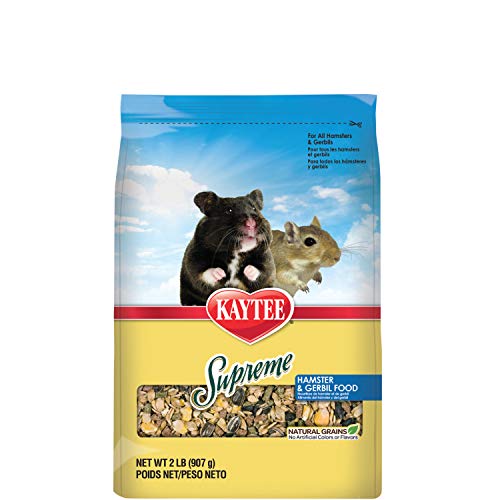
Kaytee Supreme is a simpler mix. The listing says it has natural seeds and grains, high quality ingredients, no artificial colors or flavors, and is naturally preserved for freshness. The bag window shows oat flakes, corn, pellets, and sunflower seeds. Sunflower seeds are rich in fat: a paper on sunflower seed fatty acids gives sunflower's oil content as 22 to 55 percent.
What the listing highlights
Check before you buy

This listing is titled Sunseed Vitakraft Vita Prima Dwarf Hamster Food, and the bag says dwarf hamster food. The listing names a grain blend of oats, wheat, barley, millet, sorghum, buckwheat, spelt, and quinoa, plus sunflower seeds, apple, banana, papaya, parsley, and lettuce. It adds vitamins A, D3, E, and B12, riboflavin, and probiotics, and says the food is free of artificial colors, flavors, and preservatives.
What the listing highlights
Check before you buy

The Wild Harvest Hamster And Gerbil Advanced Nutrition Diet is the only listing here that gives a serving: feed 1 to 2 tablespoons daily per hamster or gerbil. The listing says it has a large variety of grains, seeds, vegetables, and fruit, and contains fiber, protein, vitamins, and minerals. The bag also reads with flaxseeds. The listing says the mix is meant to replicate diets found in a natural habitat and to encourage foraging.
What the listing highlights
Check before you buy
PDSA says hamster pellets contain all the nutrients a hamster needs. It also says that muesli-style food is best not fed exclusively, because hamsters are likely to eat the pieces that are high in sugar and leave the ones that are high in fiber, which can cause dental problems and obesity. The Merck Veterinary Manual says seeds should be limited because hamsters might eat them instead of their balanced pellets. Researchers have studied selective eating in golden hamsters, including the effect of dietary protein restriction on selective preference for a protein-containing diet (Physiology and Behavior, 1998).
The Merck figure of 15 to 20 percent protein is for a commercial rat or mouse pellet. Protein is one of the nutrients a hamster food has to supply, and Healthline's explainer on protein in people lists tissue growth and repair among its jobs and says it "helps repair and build your body's tissues." For the nutrients they need, the National Research Council's chapter on the hamster in Nutrient Requirements of Laboratory Animals (1995) is the reference, and it says very little is known about the nutritional requirements of golden hamsters. Merck adds that extra vitamins are usually not needed.
Merck says a hamster's front teeth keep growing, and overgrown teeth can cause drooling, poor appetite, and weight loss. PDSA says timothy hay is full of fiber and helps keep teeth healthy. The RSPCA says a hamster should only be given wet or powdered food on a vet's advice, for example because of dental problems.
PDSA says a teaspoon or two of fruit, vegetables, and herbs a day is enough to add variety. Merck caps treats at 10 percent of the diet. Both are small amounts next to the main food.
The Merck Veterinary Manual says food dishes should be sturdy and easy to clean, and that ceramic bowls work well. The RSPCA says food can be scattered or hidden around the cage to encourage natural foraging, and PDSA suggests scattering pellets and burying food deep in the bedding. The Merck Veterinary Manual says hamsters hide food in the cage, and our guide to Hamster Houses covers places to hide it.
A commercial pellet or a seed mixture made for hamsters, plus small amounts of fresh food. The RSPCA describes a compound pellet ration or a mixture of seeds formulated to meet a hamster's needs as the base, with small quantities of greens, cleaned root vegetables, and fruit such as apples.
PDSA says each pellet is the same, so a hamster cannot pick out its favorite bits, and that a muesli-style mix fed on its own can lead to a diet high in sugar and low in fiber. The Merck Veterinary Manual says seeds should be limited because hamsters might eat them instead of their balanced pellets.
The RSPCA lists greens, cleaned root vegetables, and pieces of fruit such as apples, and says grapes and rhubarb can be poisonous to rodents. PDSA says a teaspoon or two of fruit, vegetables, and herbs a day is enough, and warns that sugary fruit and vegetables fed in excess can lead to obesity or diabetes.
PDSA says Russian Dwarf hamsters are particularly prone to diabetes, so sugary fruit and vegetables should not be overfed. Researchers have studied the propensity for diabetes in the Chinese hamster, a different species, and the National Research Council notes that Siberian dwarf hamsters are used in research on diabetes mellitus and obesity. Vita Prima in the list above is labeled as dwarf hamster food.
PDSA says a small amount of muesli-style food can make meals more appealing for a hamster that is bored with its pellets. The RSPCA suggests scattering or hiding food around the cage and says to avoid sudden dietary changes, because they can upset a hamster's stomach.
The National Research Council says hamsters eat at 2-hour intervals throughout the day. The RSPCA says a hamster should always have a constant supply of fresh, clean drinking water, preferably from a bottle with a valveless sipper tube.
The RSPCA says to talk to a vet immediately if a hamster starts eating less, its droppings become moist, or its hindquarters become soiled. The Merck Veterinary Manual lists drooling, poor appetite, and weight loss as signs of overgrown teeth, which a veterinarian can trim.
Leave a comment