
Your Purchase Helps
shelter pets in need
Each order helps pets in need
shelter pets in need
Each order helps pets in need

The AKC says most dogs need nail trims every three to four weeks, but that frequency depends on activity level and how quickly the nails grow. A German Shepherd is a large dog, 50 to 90 pounds on the AKC breed page, so the clippers need to be sold for large dogs and the person using them needs to know where the quick is.
Below are seven nail clippers, each described from its Amazon listing, a table that compares them, and a section on how to trim, how to work around a dog that dislikes it, and what to do if a nail bleeds. The trimming advice comes from the AKC and from VCA Animal Hospitals. Our guide to the best grooming tools for German Shepherds covers the rest of the grooming kit.
| Clipper | Sized for, per the listing | What else the listing names |
|---|---|---|
| Epica | Large size: dogs over 60 pounds, German Shepherds named | Safety guard in the title, semi-circular blades, locks closed, rubber-coated handles |
| KXCDTECH | Large dogs with thick nails | Protective guard, lock switch, metal handle, file and comb |
| Gonicc | Medium and large dogs | 3.5 mm blades, safety stop, file in the handle |
| Boshel | Large dogs, medium and large pets | 3.5 mm blades, safety stop with quick sensor, file in the handle |
| Gobeigo | Large dogs and thick nails | Martensite steel, angled handles, diamond file |
| GoPets | Large dogs and cats | Quick sensor guard, locking mechanism, built-in file |
| Mars | Great for large dogs | 6 3/8 inches long, plastic handles, made in Germany |
If clippers are not the right tool for your dog, the AKC says some dogs tolerate grinders better while others prefer clippers. Our guide, Nail Grinder for German Shepherds, covers that option.

The Epica listing names two sizes: Small/Medium for dogs under 60 pounds, and Large for dogs over 60 pounds such as Boxers, Labrador Retrievers, German Shepherds, and Great Danes. The AKC breed page lists females at 50 to 70 pounds and males at 65 to 90, so a female near the low end of that range sits close to the line between the two sizes.
The blades are semi-circular and the listing says the nail rests in the semi-circle, so you can see where you are cutting. It also names high-grade stainless steel, rubber-coated handles, and a lock that holds the clippers closed when they are not in use.
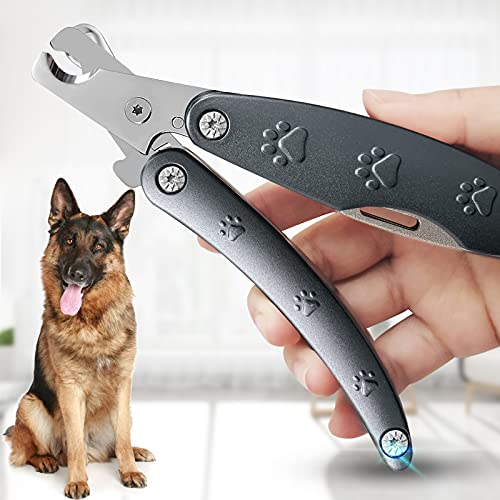
The KXCDTECH listing is titled as a heavy-duty clipper for large dogs with thick nails. It is sold as a kit of three tools: the clipper, a file, and a comb. The listing says the clipper has a protective guard, semi-circular blades, stainless steel blades, and a lock switch, and that the handle is metal instead of plastic.
Handle material differs across the list: metal here, rubber-coated on the Epica, cushioned on the GoPets, and plastic on the Mars.
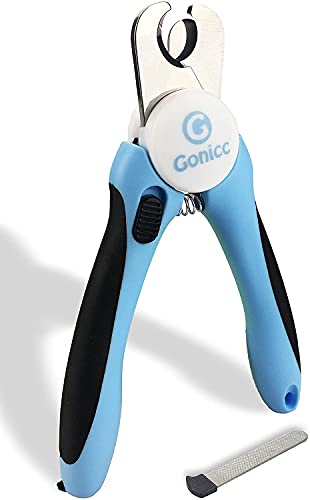
The Gonicc listing says the clippers are for medium and large dogs, with 3.5 mm stainless steel blades, a built-in safety stop that it says blocks over-cutting and protects the quick, and non-slip contoured handles. A mini nail file is hidden in the handle.
The Boshel listing below describes the same features: 3.5 mm blades, a safety stop, and a file in the handle.

The Boshel is titled a large dog nail clipper with a safety guard and a free nail file. Its listing describes 3.5 mm stainless steel blades, non-slip ergonomic handles, and a built-in safety stop designed with a quick sensor. It says the clippers suit medium and large pets.

The Gobeigo is the all-metal clipper in this list. The listing says it is made of full martensite steel and 100% stainless steel, and that it suits large dogs, old pets, and breeds with heavy nails. It says a small angle between the blade and the handles lets you see what you are doing.
The package includes a stainless steel file with diamond flakes and a gift box.

The GoPets box in the photo is labeled Large Pet Nail Clippers for large-sized pets, and the listing title says Large Dogs and Cats with a quick sensor safety guard. The listing describes stainless steel blades, a cushioned non-slip handle, a locking mechanism that keeps the blades closed, and a nail file built into the handle.

The Mars listing says the cutter was manufactured in Germany, is great for large dogs, and is 6 3/8 inches long, with stainless steel blades and plastic handles built to last.
The AKC describes the nail in two parts: the living pink quick and the hard outer shell. It says the quick supplies blood to the nail and that nerves in the quick cause bleeding and discomfort when cut. It also says regular trimming causes the quick to recede from the end, and that short quicks are the preferred length for the dog's well-being and easy maintenance.
The AKC steps are to place your thumb on the pad of a toe and your forefinger on the skin above the nail, push your thumb slightly up and backward while your forefinger pushes forward to extend the nail, and clip only the tip, straight across. It says to include the dewclaws, located on the inner side of the paw. It also says to avoid clipping past the curve of the nail, and that for dogs with dark nails, you should watch for a chalky white ring.
VCA Animal Hospitals tells new trimmers to learn how to identify the blood supply in the nail, called the quick, and what to do if a nail is trimmed too short. VCA says that when you trim, "rather than cutting once, you’ll be shaving off tiny bits repeatedly until you locate the stopping point," and suggests practicing on cocktail straws, dry pasta, and toothpicks. The AKC's chief veterinarian, Dr. Jerry Klein, suggests that someone who has never clipped a dog's nails may want a veterinarian or vet tech to give a lesson.
The AKC says most dogs need trims every three to four weeks, and that some dogs wear their nails down and will not need clipping as often. It says long nails can turn a sound paw into a splayed foot and reduce traction, and that over an extended period they can deform the feet and injure the tendons.
The AKC recommends keeping styptic powder or another clotting powder on hand in case a nail is cut too short. If that happens, it says to apply styptic powder or a clotting product immediately and stay calm, and to contact your veterinarian if the bleeding does not stop.
The AKC says to touch and hold a puppy's paws from the first day, and lays out a one-week plan: let the puppy sniff the clipper on day 1, touch it to each paw on day 2, touch it to each paw and squeeze it so the puppy hears the sound on day 3, and trim one tiny tip on day 5, with praise and a treat at each step.
For a dog that already fears nail care, VCA says the process cannot be rushed or forced. It says to break the trim into many small steps, pair each step with something wonderful, and keep sessions short (just a minute or two) and frequent (a few days a week). VCA says to avoid tricks or distractions, and that forcibly restraining the dog by hand or in a hammock or sling carries a high risk of worsening fear. If a dog shows trembling, excessive drooling, panting, growling, or snapping, VCA says to consult a healthcare professional, and that in some cases medication for anxiety or some mild sedation may be beneficial.
The AKC breed page lists male German Shepherds at 65 to 90 pounds and females at 50 to 70 pounds, so look for clippers whose listing says large dogs and compare the weight range, where it gives one, with your dog. Giant dogs are a bigger size class than a German Shepherd, and the AKC covers those large breeds on a separate page.
Guards, safety stops, and locks are features the listings describe. A lock keeps the blades closed in a drawer. A guard or stop is the maker's feature, and the AKC steps above still apply: clip the tip and watch for the quick.
Trimming a large dog's nails means squeezing the handles many times. The Gonicc and GoPets listings both describe handles that reduce hand fatigue.
The Gonicc listing says its blades make one-snip clean cuts, and the Boshel listing says clean cuts in one motion. The Epica listing says its stainless steel holds its sharp edge.
Want to keep your German Shepherd clean and safe from parasites? Check out our list of the best flea treatments for them. Our guides to Probiotics for German Shepherds and Outdoor Dog Kennels for German Shepherds cover other parts of routine care.
Leave a comment