
Your Purchase Helps
shelter pets in need
Each order helps pets in need
shelter pets in need
Each order helps pets in need

A German Shepherd needs several kinds of grooming tools: one to pull out loose undercoat, a brush to finish the coat, and something to keep the nails short. The AKC’s breed page describes the coat this way: “The German Shepherd Dog has a medium-length, double coat consisting of a dense, harsh, and close-lying outer coat with a softer undercoat.”
The seven picks below are three undercoat rakes, a slicker brush, a double-sided bristle brush, a pair of nail clippers, and a nail grinder. For deshedding tools from one brand, see our picks for the best furminator for German Shepherds.
The AKC’s brush guide says, “Choose a dog brush based on the size of your dog, their breed, and their coat type.” Here is what the AKC pages say about each tool.
| Tool | What the AKC says |
|---|---|
| Undercoat rake | Rakes have “one or two rows of metal pins designed to penetrate through to the undercoat to remove loose fur, and remove and prevent mats.” You can use them on “double-coated breeds of all fur lengths,” but “you must choose the correct pin length for your dog’s coat length.” |
| Wide-toothed comb | “Wide-toothed combs can also help remove mats and tangles.” |
| Slicker brush | Brush heads covered with “short, tightly-packed wire pins angled to go through the coat and avoid the skin.” The AKC adds, “Maintain a light touch when using slicker brushes, as pressing down hard could cause your dog discomfort.” |
| Bristle brush | You can use it “on double-coated breeds as a finishing brush to smooth the coat and add shine.” |
| De-shedding tool | In the AKC’s grooming guide, Breeder of Merit Wendy Wilson “finds that, when used correctly, a de-shedding brush alone is enough for routine brushing and de-shedding. If used incorrectly, the tool can damage your dog’s coat.” |
| Nail clippers or grinder | The AKC’s nail guide lists “nail scissors, grinder tools specifically designed for dogs, and guillotine types.” It says, “Both are safe when used correctly. Some dogs tolerate grinders better, while others prefer clippers.” |
The same grooming guide says Breeder of Merit Lisa Walsh uses the de-shedding tool for routine brushing, and that when she is showing a dog she “will use a slicker brush just before going into the ring.” Wilson advises “do the de-shedding outside,” because of the amount of fur the tool releases.
The AKC pages give different numbers. Each row below credits the page that says it.
| Task | What the AKC pages say |
|---|---|
| Brushing | The breed page says the coat is “easy to maintain, usually requiring just a quick brushing every few days or so to help remove loose hairs, but they do shed more profusely once or twice a year. During these periods, more frequent brushing will help control the amount of hair that ends up around the house and on the furniture.” In the grooming guide, Wilson recommends brushing every other day, and Walsh mostly uses her tool weekly, “increasing in frequency to daily during heavy shedding periods.” |
| Bathing | The breed page says, “The German Shepherd only needs an occasional bath.” Walsh says “once or twice a year is sufficient,” and notes that bathing too often “strips their coat and skin of natural oils.” |
| Nails | The breed page says it is important to “trim or grind his nails every month if they are not worn down naturally.” Wilson’s dogs on carpet and grass need a trim “every two to three weeks,” and Walsh’s dogs not on pavement need one “at least monthly.” The nail guide says, “Most dogs need nail trims every three to four weeks, but frequency depends on activity level and how quickly the nails grow.” |
| Shaving | Wilson says, “The GSD’s double coat acts as an insulator, keeping them cool in the summer and warm in the winter. So I wouldn’t shave them.” |
The AKC’s brush guide says, “Remember to brush the undercoat, as well as the top coat, if your dog is double-coated.” It also says brushing “gives you the opportunity to notice anything unusual, such as cuts or sore spots.”
That guide names three tools for a double coat: the undercoat rake, the slicker brush, and the bristle brush used as a finishing brush. Picks 1 to 5 below cover all three. For more brush and rake picks, see our guide to the best dog brush for German Shepherds.
Check price and stock on each listing before you buy.
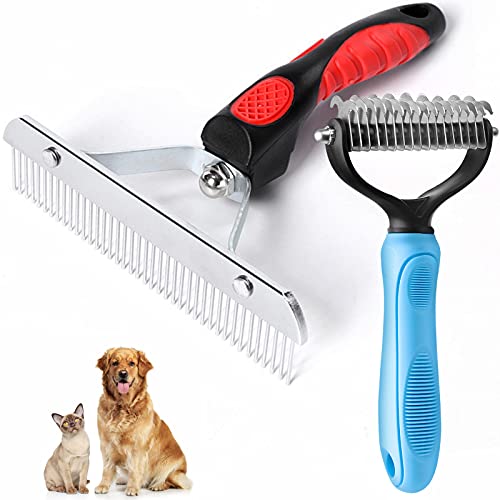
This is a two-tool set. The listing describes “a raking comb with wide of teeth and a double-row deshedder brush,” and says the set is “Ideal for opening tangles and grooming fluffy coats of medium to large sized dogs and cats.”
What the listing says

A dual-sided rake. The listing says to “start with a 9-teeth side to tackle stubborn mats and tangles, and finish with a 17-teeth side to thin out and deshed after.”
What the listing says

An undercoat rake. The listing calls it a “Great choice for medium to long haired coats like husky,german,golden retriever.”
What the listing says

A slicker brush. The listing title ends in “Firm Pins, Teal, Large,” and the listing says, “Firm for shedding dogs, like German Shepherds, Alaskan Malamutes, Australian Shepherds, Golden Retrievers, Springers.” Check that the Firm Pins, Large option is selected before you buy.
What the listing says

A double-sided brush with bristles on one side and pins on the other. The AKC says a bristle brush can be used on double-coated breeds as a finishing brush. The listing says, “Soft bristles are used to smooth and shine the coat while the stainless-steel pins are used to remove deep lower level fur that normal bristles miss.”
What the listing says

A pair of clippers sold in two sizes. The listing says to choose “Small/Medium for dogs under 60 pounds” or “Large for dogs over 60 pounds such as Boxers, Labrador Retrievers, German Shepherds and Great Danes.” The AKC gives the German Shepherd’s weight as 65-90 pounds for males and 50-70 pounds for females, so check which size the listing shows.
What the listing says

A cordless electric grinder. The AKC’s nail guide says, “Some dogs tolerate grinders better, while others prefer clippers.” In the grooming guide, Walsh says that for some dogs, particularly those with thick nails, she has to use a Dremel tool for nail grinding in addition to dog nail clippers.
What the listing says
German Shepherds have a double coat with a thick undercoat and a coarser outer coat. We'll want tools that can effectively deal with both.
The AKC says you must “choose the correct pin length for your dog’s coat length,” so read the tooth length on a rake listing. The Tsxurepaw comb lists steel teeth of 0.94 inch, and the Jelly Pet slicker lists pins that reach more than three quarters of an inch.
The AKC’s allergy page says, “Dogs can develop allergies to flea bites, certain foods, and environmental allergens, causing everything from itchy skin and recurring ear infections to facial swelling.” It also describes, in rare cases, severe allergic reactions, and adds that it is important to “get an accurate diagnosis from your veterinarian before pursuing treatment.”
For the tools, the AKC says slicker pins are “angled to go through the coat and avoid the skin.” The OCTCHOCO listing says “No scratch rounded outside teeth,” the Tsxurepaw listing says “smooth, rounded rake teeth,” and the Maxpower listing says “sharpened but finely rounded.” For the food side of skin trouble, see our guide to dog food for German Shepherds with sensitive skin and allergies.
The AKC’s brush guide says, “You can’t expect to use the same size brush on a Chihuahua and a Saint Bernard. Choose an appropriate brush size for the size of your dog.” It also says, “You’ll thank yourself for buying a dog brush with a comfortable, ergonomic handle after a long grooming session.” Listings that mention the handle or grip include Maxpower (“a lightweight, comfortable handle and a non-slip rubber base”), OCTCHOCO (“Soft Anti-slip rubber handle”), Jelly Pet (“lightweight, ergonomic design”), Wahl (“a soft touch grip”), and Epica (“non-slip rubber coating”).
The listings make their own claims about materials. OCTCHOCO lists “Heavy-duty stainless steel,” Epica lists “high-grade stainless steel” that “holds its sharp edge and won’t dull,” Wahl lists stainless-steel pins, the Tsxurepaw comb lists steel teeth, and Casfuy lists a “diamond bit wheel.”
The AKC’s brush guide says, “Some types of brushes, particularly slicker brushes, have a self-cleaning function. This consists of pins that retract at the press of a button, so you can easily remove hair and dirt.” Look for that button on a slicker listing if you want it. For other gear, see our picks for the best leashes for German Shepherds.
It depends on the job. The AKC’s brush guide says undercoat rakes work on “double-coated breeds of all fur lengths,” and a bristle brush works “as a finishing brush to smooth the coat and add shine.” In the grooming guide, Walsh uses a slicker brush before showing a dog.
Yes, when it is used correctly. The AKC’s grooming guide says Wilson “finds that, when used correctly, a de-shedding brush alone is enough for routine brushing and de-shedding. If used incorrectly, the tool can damage your dog’s coat.”
A wide-toothed one. The AKC says, “Wide-toothed combs can also help remove mats and tangles.”
For most dogs, every three to four weeks, according to the AKC’s nail guide, which adds that the right schedule “depends on activity level and how quickly the nails grow.” The breed page says every month if the nails are not worn down naturally.
Leave a comment