
Your Purchase Helps
shelter pets in need
Each order helps pets in need
shelter pets in need
Each order helps pets in need

A basket muzzle sized to the length of a German Shepherd's snout is the right muzzle for almost every situation, because the dog can still pant, drink, and take treats while wearing it. Veterinary behaviorists at VCA Animal Hospitals say basket muzzles are preferred over the nylon sleeve kind for exactly that reason. The six muzzles below were all listed as in stock on Amazon when this page was updated, and each one comes with the size numbers from its own listing.
Size matters more than brand. German Shepherds have a long snout, and a muzzle built for a short-faced breed will rub the nose or slide off. Measure first, pick a material second, and plan to train the dog to wear it before you need it.
This table lists each muzzle, what it is made of, and the measurements its listing gives. Every brand sizes differently, so compare your dog's numbers with the chart on the listing you plan to buy.
| Muzzle | Material | Size numbers on the listing |
|---|---|---|
| Baskerville Ultra, size 5 | Thermoplastic rubber | Six sizes, fitting guide on the listing |
| BARKLESS silicone basket | TPE silicone | Size chart on the listing, measure circumference and length |
| BARKLESS cage muzzle, size L | Soft, pliable cage | Size chart on the listing, listing names German Shepherds |
| PetriStor stainless wire | Stainless steel wire | S: 11 to 12.6 in around, 4.3 to 4.7 in long. M: 11.4 to 13.5 in, 3.9 to 5.1 in. L: 13 to 15 in, 5 in |
| CleverTail steel basket | Polished steel, leather straps | 13 in around, about 4 in long |
| OOPSDOGGY leather, Large | Leather cross-weave | 12 in around, 5.5 in long |
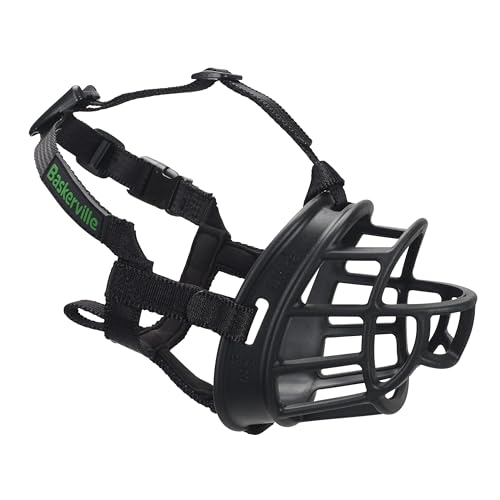
The Baskerville Ultra is the muzzle the Muzzle Up Project, a trainer-founded group, calls "the gold standard for a safe and comfortable basket muzzle." The listing says the thermoplastic rubber can be heat shaped in warm water to match a dog's nose, and that the basket has a lockable neck strap clip, a head strap, and a collar attachment. It also says the straps are padded and that no metal touches the dog's face. This listing is size 5, so check the Baskerville fitting guide against your dog's measurements before ordering.
One drawback comes up in the Muzzle Up Project's equipment guide: supporters report that on some dogs the plastic rubs the skin above the nose, and strips of fabric on the plastic can help. If your Shepherd has a sensitive nose bridge, plan for padding.

This muzzle is made of TPE silicone, and the listing says it can be heated and shaped for a tailored fit around the snout. It has a W-shaped design that the listing says keeps the basket away from the dog's eyes.
The listing asks buyers to measure both circumference and length. If the circumference matches one size but the length runs about an inch over that size's maximum, it says to choose the next size up. For a long-snouted breed like a German Shepherd, that length rule is the one to watch.

This is the size L cage muzzle from BARKLESS. The listing names Golden Retrievers and German Shepherds as reference breeds and tells buyers to measure the snout before ordering. It describes the material as pliable and softer than a hard cage, with bar spacing that lets a dog pant, drink, and take treats. Adjustable head and neck straps let you tighten it, and the listing says the twist in each strap is part of the design.
The straps are the part to fit with care. The listing warns that a wrong size, a loose fit, or no muzzle training can all lead to a dog getting the muzzle off.
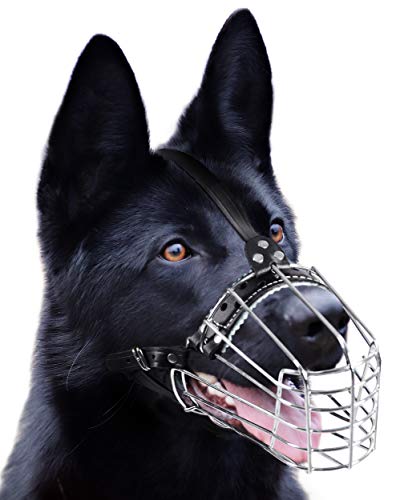
PetriStor sells a stainless steel wire basket with adjustable straps, and the listing says it allows panting, drinking, and small treats. It comes in three sizes, each its own Amazon listing. The link above opens size S, which is listed for a snout 11 to 12.6 inches around and 4.3 to 4.7 inches long. Size M covers 11.4 to 13.5 inches around and 3.9 to 5.1 inches long (size M listing). Size L covers 13 to 15 inches around and 5 inches long (size L listing).
The Muzzle Up Project notes that wire muzzles are typically heavier than plastic ones and that the metal can be uncomfortable in hot or cold weather. Check the weather before a long outing.
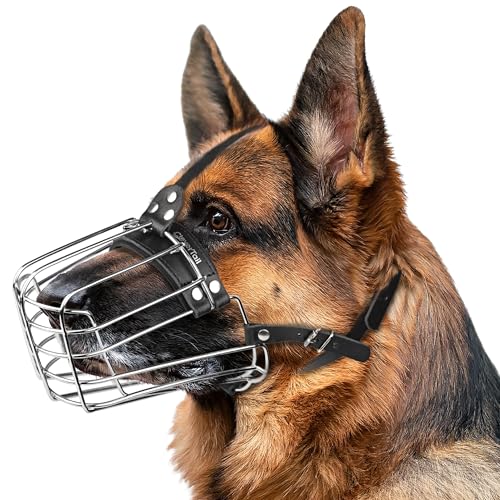
The listing describes polished steel with genuine leather and adjustable leather straps, and it lists German Shepherd, Husky, Belgian Malinois, Golden Retriever, Doberman, and Collie as fitting breeds. For sizing it gives one target: a snout about 13 inches around and about 4 inches long.
That length is shorter than the 5 inches several other listings use for large dogs. A Shepherd with a long snout should be measured before choosing this one.

The listing describes genuine leather with stainless steel rivets, adjustable leather straps, and a breathable cross-weave. The Large size is listed for a snout 12 inches around and 5.5 inches long, and the listing asks buyers to measure both.
The Muzzle Up Project points out that leather basket muzzles can be hard to fit and that some designs make eating and drinking difficult. With any leather weave, test that a small treat and water can get through before you rely on it.
Every brand has its own size chart, and the Muzzle Up Project says plainly that each brand has specific sizing. The two numbers every chart above asks for are the circumference of the snout and its length. Follow the chart on the listing you plan to buy for exactly where to place the tape.
VCA lists what a good fit looks like: the muzzle is sturdy enough to prevent a bite, lets the dog pant and eat treats, does not sit on the soft part of the nose or the nostrils, does not touch the eyes, and cannot be removed by the dog. Cornell's veterinary school adds that the strap should not slip over the head, with one or two fingers fitting under it.

If your dog cannot pant freely with the muzzle on, it is too tight. A heat-shaped muzzle such as the Baskerville or the BARKLESS silicone can be adjusted with warm water, according to their listings. Straps take a lot of force from a strong dog, so the same fit rules apply to other gear, such as the best harness for German Shepherds.
VCA describes two common types, the basket muzzle and the sleeve muzzle made of nylon or mesh. A sleeve muzzle is snug and does not let a dog pant or show warning signals, and VCA says it should be used only in an urgent situation with no alternative, for very short periods. The American Kennel Club adds that soft muzzles prevent panting, which is how dogs release heat, so they should never be used in hot weather.

A basket muzzle avoids both problems. The AKC says most styles let dogs open their mouths to pant, drink, and eat, and the Muzzle Up Project says never to use a cloth or grooming muzzle for extended wear. Because a Shepherd can take treats through the bars, you can keep rewarding good behavior while the muzzle is on.
Start before you need the muzzle. The AKC points out that if the first time a dog wears one is after an injury or in a scary moment, getting it on will be much harder. Cornell says puppyhood is an ideal time to start, and if you have a new puppy and have not chosen a name yet, our list of Names for German Shepherds can help. Use small, soft treats and keep early sessions to a minute or two. VCA's steps are:
If the dog hesitates or backs away, do not coax. VCA says that is a sign of fear, and a behavior professional is the right next step. A muzzle also does not fix a behavior problem. VCA and the AKC both say not to use one to stop barking or chewing, and the AKC says it is for short, supervised periods. Take the muzzle off before chew time with the best bones for German Shepherds. The AKC says a muzzle can help during grooming while a dog is still learning to accept handling, and our Nail Grinder for German Shepherds guide covers the tool for nail trims.
Your dog should not be able to remove the muzzle on their own. Period. Look for backup attachment points (like collar loops) and locking buckles. If you walk your dog in the evening, reflective elements on the straps are a nice bonus.
Offer water often. Cornell says never to leave a muzzle on an unattended dog, because it can come off and the dog could chew or swallow pieces of it.
Cornell recommends washing the muzzle in warm soapy water after each use. Let it dry fully, and check the buckles and straps for wear before the next outing.
For more care guides for the same dog, see our picks for salmon oil supplement and the best hip and joint supplements for German Shepherds.
Leave a comment