
Your Purchase Helps
shelter pets in need
Each order helps pets in need
shelter pets in need
Each order helps pets in need

A catio, also called an outdoor cat enclosure, is the safest way to give an indoor cat time outside. The PDSA, a UK veterinary charity, describes a catio as “a completely enclosed area where your cat can safely spend time outside.” Below are three of the best outdoor cat enclosures from Amazon, plus answers on whether cats like them, whether a cat can live in one, and what a safe one needs. Pet parents who want more options can also read about outdoor pet enclosures.
International Cat Care, a veterinary cat charity, says “it’s possible to keep an active cat in a safe outdoor environment, so, in most cases, there’s no need to keep them solely indoors.” It also says there are “options available regardless of whether you have a patio, balcony or large garden”.
For most pet parents, yes, when the enclosure is secure. International Cat Care says: “There are many advantages to providing your cat with an enclosed outdoor space, with their safety high on the list.”
Cats are social animals and love to wander around and explore the outdoors, but it is not always safe for them to be outside unsupervised. The ASPCA says: “Outdoor cats are at risk of trauma from cars, or from fights with other cats, raccoons and free-roaming dogs. Coyotes are known to eat cats.” PETA, which opposes letting cats roam, says “cats who are let outdoors without supervision are vulnerable to the dangers of cars, other animals, cruel people, and diseases.”
International Cat Care lists the same kinds of risks in one sentence: a cat outdoors could “pick up a harmful disease, get into cat fights, eat something poisonous, be hit by a car, or get lost”. An enclosed run is how many pet parents give a cat outside time without those risks.
Indoor life has its own cost. The PDSA says: “The main risk of keeping a cat indoors is that they won’t get a chance to exhibit some of their natural behaviours, such as climbing, jumping, hunting and generally exploring.” International Cat Care adds: “The biggest issue facing indoor-only cats, is the potential negative impact on their mental wellbeing which can lead to long-term stress and subsequent physical illness.”
Most cats do enjoy outside space. Cats Protection, a UK cat charity, says: “Most cats love having space outside to explore and should have the freedom to do so.” International Cat Care says: “The outdoors can provide a larger, more varied and stimulating environment for your cat to enjoy.”
Cats that already live indoors can adapt. International Cat Care says: “Cats that have always been kept indoors adapt well, provided they’re given plenty of companionship, attention, and things to stimulate them.” It also says: “However, with most cats, being confined indoors isn’t ideal, so a solution where they can have safe access to an outdoor space, as well as the house, is perfect.”
The PDSA gives this advice for a cat that does not enjoy being indoors: “Try to find a way they can safely go outside. You could consider cat proof fencing or a ‘catio’.”
A catio is built for time outside, with the house as the cat’s base. Sources describe two layouts. International Cat Care lists “a completely self-contained run” and “a run attached to the house, so your cat can have equal access to the house and their outdoor space.”
Cats can have a happy life indoors, but if you want your indoor cat to experience the outdoors in a controlled environment, buying or building outdoor cat enclosures will provide your cat with a safe way to play and get exercise.
Weather decides how long a cat should stay out. International Cat Care says: “It’s important to make sure your cat is protected from the weather at all times of year, either by having access to the house through a cat flap or window, or by providing a purpose-built cat house within the enclosure itself.” For a self-contained run, it says to “make sure there’s some form of cat house within it, giving your cat somewhere to escape any bad weather.”
Not every group agrees on outside time. The ASPCA says: “Please keep your cat indoors.” International Cat Care says: “There’s no right or wrong answer when it comes to either keeping your cat indoors only or allowing them to explore outdoors.”
Outdoor cat enclosures are available in a variety of styles and price ranges. Companies sell catios that run from simple to elaborate. Whatever you pick, a few features matter more than the style.
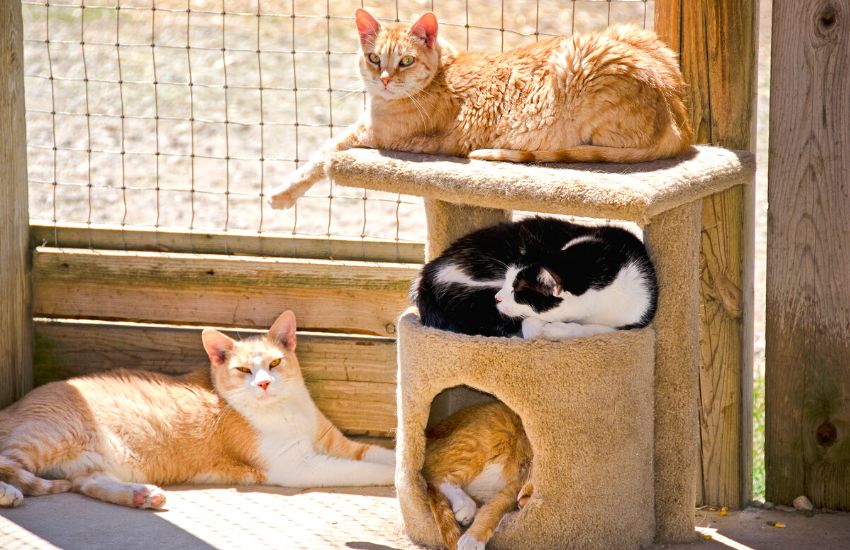
Many pre-fabricated runs, enclosures, and pens for our feline companions feature tunnels, perches, and enclosed spaces for extra protection. Several styles feature tarps that serve as a roof to protect multiple cats from the elements.
Shade and water matter too. The RSPCA says: “Ensure your cat always has access to shade and fresh drinking water to help keep them cool.” The PDSA warns: “The most common cause of heat stroke in cats is being accidentally trapped in a hot, poorly ventilated space such as a shed, greenhouse, conservatory, or garage.”
Add hiding places and play areas. Cats Protection says: “Cats might feel threatened in an open space, so make sure your garden has plenty of places to hide.” International Cat Care says: “Whatever type of enclosure is created, it’s important to provide play areas for your cat.” It adds: “Providing scratching posts, shelves and climbing frames made from tree branches will help keep your cat entertained.” If your cat needs help learning to use a post, see how to teach your cat to use scratching posts.
Choose plants with care. International Cat Care says that when a cat “only has access to an outdoor run or catio, it’s vital to make sure there are no hazardous plants in the home or their outdoor space.” It also says: “Lilies are extremely dangerous.”
Finally, lock the door. International Cat Care says: “Any doors or gates providing people with access to the cat enclosure should have a security catch which can be closed and locked with a padlock.”
These three picks cover the main kinds of outdoor cat enclosure: a walk-in wooden catio, a multi-level wooden catio with a cat house, and a pop-up tent. Product details below come from each maker’s Amazon listing and are credited to the maker.

The Grepatio Cat Enclosure is a wooden catio with a galvanized iron mesh. Grepatio’s listing says it has a waterproof asphalt roof, five large platforms, and a removable sleeping house. The listing also describes an oversized front door with a safety latch and a walk-in style for feeding and cleaning. Grepatio says the catio ships with detailed instructions and recommends two people for installation. Get the Grepatio outdoor catio if you want a walk-in wooden enclosure for a patio or deck.

PetsCosset describes this enclosure as a four-level wooden catio made of water-based fir wood and metal mesh, with reinforced brackets on each corner. The listing says it has two resting rooms, five platforms, two escape doors, and a removable waterproof cover. PetsCosset also says it can be used as a window enclosure, connected to a pet door, or joined to other cages or cat tunnels. The PetsCosset catio fits pet parents who want a tall enclosure with a cat house built in.

The EighteenTek Pop-up Cat Tent is a portable tent, not a permanent catio. EighteenTek’s listing says it needs no tools, has three levels with two removable hammocks, and uses tear-resistant mesh over a steel frame with a waterproof floor. The listing gives the tent size as 42.6 inches across and 27.6 inches high, and says it weighs 4 pounds and packs into a carrying case. EighteenTek says it can be used in a backyard, on a balcony or deck, or indoors. The EighteenTek pop-up tent suits pet parents who want a portable option.
If you build a catio instead of buying one, International Cat Care has a few checks. It says “wooden structures will need to be protected from weather damage” and to “just check that any wood preservatives used don’t contain substances that are harmful to cats and ensure the product has dried fully before allowing your cat access to the area.” For wire, it says: “Where wiring of any kind is used, check it regularly for signs of wear and tear or damage.”
It also says a self-contained run “will also need to be large enough for you to access it easily to clean.” Read more about apartment cat enclosures if your outdoor space is a balcony or a small patio.
No. Many experts recommend giving your indoor cats access to secure outdoor enclosures. This lets them get sunlight and plenty of space for exercise. If your catio is safe and secure, it's an excellent way for your pet to have time outside.
It depends on the kitten’s age. Kittens are more vulnerable than adult cats. International Cat Care gives this advice for kittens going outdoors: “We don’t recommend allowing kittens free access outdoors until they’re microchipped, fully vaccinated and have recovered from being neutered.” It adds: “It is advisable to start with supervised sessions outside until your kitten is 6 months old.”
Not always. International Cat Care says an enclosure “can be open at the top, with an overhang like that used on fencing, or completely enclosed with a roof.”
Heat is a risk for cats in closed spaces. The PDSA says: “The most common cause of heat stroke in cats is being accidentally trapped in a hot, poorly ventilated space such as a shed, greenhouse, conservatory, or garage.”
Be proud of your furry companion, and get apparel to show the world how special your cat is.
Leave a comment