
Your Purchase Helps
shelter pets in need
Each order helps pets in need
shelter pets in need
Each order helps pets in need

A bark collar sits on the dog’s neck and responds when the dog barks. The American Veterinary Society of Animal Behavior (AVSAB) recommends that only reward-based training methods are used for all dog training, and the American Kennel Club (AKC) and VCA Animal Hospitals both describe what to try for barking before or alongside a collar. This page covers what those three say, then compares seven collars for dogs of German Shepherd size on the facts each Amazon listing states.
AVSAB says a reward-based trainer may use “toys, treats, or other appropriate reinforcers to reward the behavior.” Treats are one of the rewards it names, so a pet parent can pick from the best dog treats for German Shepherds.
AVSAB’s position statement on humane dog training says: “Evidence supports the use of reward based methods for all canine training.” It also says: “There is no evidence that aversive training is necessary for dog training or behavior modification.”
The statement answers the shock collar question by name. In its list of what a trainer should avoid, AVSAB includes “any use of training tools that involve pain (choke chains, prong collars, or electronic shock collars)”. Its conclusion reads: “AVSAB recommends that only reward-based training methods are used for all dog training, including the treatment of behavior problems.”
On barking in particular, the statement says: “Common training issues such as jumping, barking, and housetraining can be managed by arranging the environment appropriately and reinforcing desirable responses.”
A study protocol published in PLOS ONE, Improving dog training methods: Efficacy and efficiency of reward and mixed training methods, says “the scientific literature on the efficacy and efficiency of the different methodologies is scarce and inconsistent.” The protocol plans to train 30 military and police dogs with either reward methods or mixed methods and to find which training method is the most efficient method by counting “the number of sessions required for the dogs to learn the tasks.” Its introduction says Yin et al (2008) “demonstrated that dogs could be trained with a remote-controlled food reward dispenser not to bark excessively, jump and crowd around the door when people arrived.”
The AKC’s guide to curbing excessive barking says “dogs bark for many different reasons” and lists attention-seeking, boredom, fear, excitement, frustration, and territorial behavior. It adds: “Understanding why a dog is barking is the most important step in developing an effective training plan.”
VCA’s article on barking, written by Debra Horwitz, DVM, DACVB, and Gary Landsberg, DVM, DACVB, DECAWBM, says “for dogs, barking is natural.” It adds: “Barking also occurs during times of indecision, anxiety, or frustration. Medical problems can also contribute to vocalization, especially in the older dog.”
The AKC teaches a quiet cue in steps: “Wait for your dog to stop barking, even if it’s just for a second. As soon as they stop barking, give them a delicious dog training treat.” VCA says “Training the dog to be “quiet” on command is an invaluable aid for controlling undesirable barking.”
VCA says that when excessive barking “has been going on for some time,” a dog may have separation anxiety, and it tells readers to “consult your veterinarian for treatment options.”
VCA says that when barking happens while the pet parent is away, “bark activated products (in conjunction with environmental modification and retraining) are often the most practical means of deterring inappropriate barking but are usually ineffective if the underlying cause is anxiety.” It also says: “Most importantly, bark collars only work when they are on the dog.”
The AKC says spray collars, ultrasonic devices, and e-collars all work on the principle of positive punishment, meaning the dog receives a negative consequence when it barks. The AKC says to seek the help of a certified professional dog trainer or animal behaviorist before using such tools.
All seven collars below detect barking on the collar itself, with no remote. A remote trainer is a different product, sold as a shock collar or e-collar. The AKC lists adult German Shepherds at 65 to 90 pounds for males and 50 to 70 pounds for females, so check each weight range against your dog.
| Collar | Triggered by | Modes and levels |
|---|---|---|
| SportDOG NoBark SDC-8 | Bark detection | 8 levels of static stimulation |
| Kollgux | Bark detection | Beep, vibration, beep + vibration, adjustable static |
| NBJU | Bark detection | Beep, vibration, or shock; 7 sensitivity levels |
| Dogrook No Shock | Microphone | 2 vibration modes, 7 sound stages |
| FAFAFROG | Bark recognition chip | 4 working modes, 5 sensitivity levels |
| SportDOG NoBark 10 | Bark detection | 10 static levels, 2 programmable modes |
| 15-120 lb No Shock | Bark detection | Beep, vibration, beep + vibration; 7 levels |
| Collar | Dog weight and neck size | Water |
|---|---|---|
| SportDOG NoBark SDC-8 | Not listed | Waterproof, DryTek |
| Kollgux | 5 to 150 lbs; neck size not listed | IP67 |
| NBJU | About 8 to 120 lbs; neck 7.8 to 25 in | IP67 |
| Dogrook No Shock | 12 to 110 lbs; neck up to 22 in | Waterproof |
| FAFAFROG | 8 to 150 lbs; neck 8 to 25 in | IP67 |
| SportDOG NoBark 10 | 8 lb and up; neck 5 to 22 in | Submersible to 25 ft |
| 15-120 lb No Shock | 15 to 120 lbs; neck size not listed | IPX7 |

The listing says the SDC-8 uses “Silent Partner bark detection filters out external noise” and “automatic shutoff after 80 seconds.” It describes a “Nylon adjustable fit collar with snap closure” and says the collar is “powered by a long-lasting replaceable battery.” The listing’s size field reads “Collar Receiver without strap,” so check the product page for what ships in the box.

The listing says the collar uses recognition technology to “analyze your dog’s barking pattern and respond more accurately.” It lists “Soft silicone contact covers” and says “approximately 2-hour charging provides up to 20 days of standby time” over USB-C. The listing says to “Choose Beep, Vibration, Beep + Vibration, or Adjustable Static Stimulation, then fine-tune the intensity.”
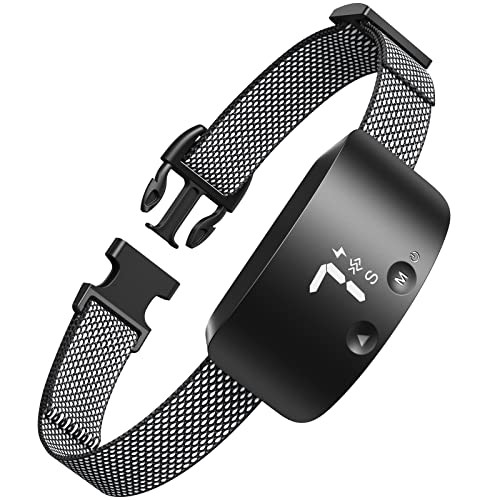
The NBJU listing offers “3 working modes” with “7 adjustable sensitivity levels” and describes “a protection system that temporarily stops working for 1 mins if it has been activated 5 times in a row.” It lists “silicone sleeves that can protect your dog’s skin” and says the collar “can be fully charged in 30 mins for up to 15 days of work time.”

The listing says the collar has “a microphone that precisely detects your dog’s unique bark.” It lists “additional prong covers for long-haired dogs” and “up to 14 days of use after recharging.”

The listing says the collar has “4 working modes; 5 adjustable sensitivity levels” and a bark recognition chip with “2 activation conditions: The dog keeps barking and vibration from vocal cords (No remote).” It says the collar is “suitable for dogs weighing 8 to 150 lbs with neck sizes from 8 to 25 inches” and “ideal for dogs over 6 months old.” The listing adds that “If the dog bark collar has been activated 6 times continuously, it will stop working for 30 seconds,” and that “A full charge in 2 hours works for about 15-20 days.”

The listing says its Silent Partner system “requires BOTH vibration from the vocal cords AND the sound of a bark to trigger a correction.” It describes two modes: “Progressive Correction mode starts at Level 1 and increases one level each time your dog barks, resetting after 30 seconds of quiet,” and “User Select mode lets you set a fixed correction level.” The listing adds “After 80 seconds, the collar automatically shuts off for 3 minutes,” and gives “up to 200 hours of use per full charge” with a charge that takes “2 hours.”

The listing says the collar “uses only beep and vibration” and says “no shock.” It lists “3 customizable training modes (beep with 5 varying frequencies, vibration, or beep+vibration)” and “7 adjustable sensitivity levels.” The listing gives the weight range as 15 to 120 pounds, an “IPX7 waterproof design,” and about 15 days of standby time or 5 to 7 days of active use per charge. It says “it is recommended not to wear the collar for more than 10 hours per day.”
Other gear for walks: the best muzzles for German Shepherds.
The second table gives each listing’s dog weight, neck size, and water rating. The SDC-8 listing gives no weight range or neck size, so compare its product page with your dog’s weight and neck measurement before you order.
The listings differ on what the collar does when it detects a bark. The SDC-8 and SportDOG NoBark 10 listings describe static levels. The Kollgux and NBJU listings name beep and vibration next to static or shock. The Dogrook, FAFAFROG, and 15-120 lb listings name beep or vibration modes.
For dogs with sensitive skin, The Kennel Club lists “excessive scratching”, “hair loss”, and “dry patches” among the signs, and says: “If your dog is scratching or licking excessively then it’s time to contact your vet to get an accurate diagnosis and find suitable treatment as soon as possible.”
VCA says “Bark-activated collars are useful when barking does not occur in a predictable location.” The SportDOG NoBark 10 listing describes its collar this way: “A neighboring dog’s bark, a TV, or ambient noise will not trigger the collar. Only your dog’s bark does.”
The AKC lists adult males at 65 to 90 pounds and adult females at 50 to 70 pounds. The Kollgux, NBJU, Dogrook, FAFAFROG, SportDOG NoBark 10, and 15-120 lb listings give dog weight ranges of 5 to 150, about 8 to 120, 12 to 110, 8 to 150, 8 and up, and 15 to 120 pounds, in that order. The SDC-8 listing gives none.
The Dogrook and 15-120 lb listings describe no shock collars with beep and vibration modes. The FAFAFROG listing names beep and vibration in its title and does not name static. The Kollgux and NBJU listings name beep or vibration next to static or shock modes. The two SportDOG listings describe static correction levels.
More reading for a German Shepherd: Best Dog Brush for German Shepherds.
Leave a comment