
Your Purchase Helps
shelter pets in need
Each order helps pets in need
shelter pets in need
Each order helps pets in need

A probiotic is a supplement of live bacteria, and it is not a treatment. A dog with ongoing stomach trouble needs a vet, not a new supplement. Texas A&M's veterinary college says probiotics “will not treat other health issues,” and that a pet with chronic or severe vomiting, diarrhea, or changes in appetite should go to a veterinarian.
The seven dog probiotics below are all sold on Amazon. For each one this page gives the form, the bacteria and live count the listing names, and the directions from the listing. Cornell's College of Veterinary Medicine says a label should carry the exact species and the number of microorganisms, so the comparison table is built around those two things. Stomach upset and skin irritations and allergies are separate problems, and a vet is the person to sort them out.
Dr. Emily Gould of the Texas A&M Veterinary Medical Teaching Hospital describes the purpose this way: “The purpose of administering a probiotic would be to replenish ‘good bacteria’ in the pet’s gut in order to restore a healthier intestinal gut ecosystem, correcting the imbalance.” The college's article gives antibiotics as one cause of that imbalance, because they can also decrease beneficial bacteria.
The same article says there are “limited studies on probiotics in veterinary medicine.” Dr. Gould says probiotics “are usually not a sole treatment” for dogs and cats with chronic intestinal disorders, and that “Other diagnostics and therapeutics are usually necessary to find the root of the problem and treat it.” If your German Shepherd has loose stool, vomiting, or a poor appetite that keeps coming back, book the vet visit first. A probiotic can be added to the plan after that, if the vet agrees.
The FDA's page on pet food regulation says: “As opposed to an animal drug, food for animals doesn’t need FDA’s pre-market review to be legally marketed (unless the substance is a food additive).” It also says that “products marketed as dietary supplements for animals don’t fall under DSHEA and FDA doesn’t recognize them as a special category. Rather, the agency regulates these products as either food for animals or animal drugs, depending on their composition of ingredients and intended use.”
Cornell's College of Veterinary Medicine says: “The manufacturer should be able to provide support for the efficacy of the product, preferably a study by an external, accredited researcher.” Dr. Joseph Wakshlag, a Cornell professor of clinical nutrition, recommends FortiFlora and Proviable as probiotic products with efficacy studies behind them, so both are in the list below.
The table lists what each listing names. The sections after it give the directions from each listing and anything else worth knowing before you buy. Check the price and stock on each listing.
| Product | Form | Count and bacteria named on the listing |
|---|---|---|
| Native Pet Probiotics | Powder | 6 billion CFUs from 4 strains: Bacillus coagulans, Enterococcus faecium, Bifidobacterium animalis, Bifidobacterium bifidum |
| Purina Pro Plan FortiFlora | Powder packet | Enterococcus faecium SF68, 1x10^8 CFU on the active ingredients line |
| Nutramax Proviable | Chewable tablet | 5 billion CFU per tablet: Enterococcus faecium, Bifidobacterium bifidum, Streptococcus thermophilus, Lactobacillus acidophilus, L. bulgaricus, L. casei, L. plantarum |
| TummyWorks Chews | Soft chew | 5 billion CFU per chew: ten species named, from Lactobacillus, Bifidobacterium, and Enterococcus faecium |
| Pet Honesty Probiotics Chews | Soft chew | 6 billion CFU blend; ingredient list names Bifidobacterium bifidum, Enterococcus faecium, five Lactobacillus species, and Bacillus subtilis |
| Bark&Spark Canine Probiotics | Soft chew | Ingredients line reads “Probiotics, Digestive Enzymes, Prebiotics, Fiber” |
| Coco and Luna Probiotics | Soft chew | Active ingredients name Bifidobacterium longum, B. bifidum, Enterococcus faecium, and five Lactobacillus species, plus FOS and inulin |
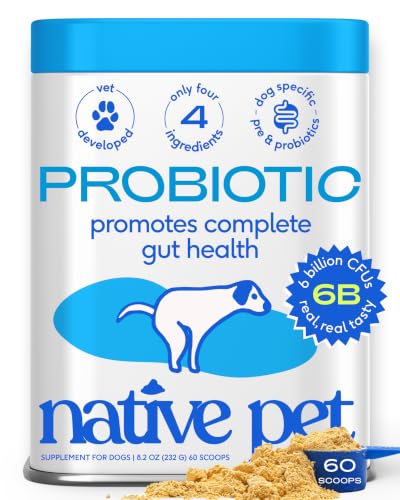
Native Pet is a powder, and the directions on the listing read: “Sprinkle powder over food. Use 1 scoop (1/2 tbsp) for every 50 lbs of body weight (example: a 15 lb. dog would receive 1 scoop & an 80 lb. dog would receive 2 scoops). Shake well before using. Use daily or as needed.” The listing says the formula was developed by a board-certified veterinary nutritionist and that the powder is shelf-stable, with no refrigeration needed.
The ingredient list starts with dehydrated beef broth, then organic pumpkin seed and organic inulin from Jerusalem artichoke, then the probiotic blend.

FortiFlora is sold as a Pro Plan Veterinary Supplement, and Cornell's Dr. Wakshlag names it as a probiotic with efficacy studies behind it. The directions on the listing are short: “Feed one packet to your dog daily or as directed by your veterinarian.”
The ingredients line starts with animal digest and also lists brewers dried yeast, and the active ingredients line adds liver flavor and yeast as inactive ingredients.

Proviable is the second product Dr. Wakshlag names. The directions on the listing say: “For dogs of all sizes: Give 1 tablet daily or as directed by your veterinarian.” The listing says the tablet can be hand fed or broken into smaller pieces and mixed with food.
The ingredient list includes natural flavor, and each species is listed with its strain number on the guaranteed analysis line, for example Enterococcus faecium NCIMB 30183.

The label gives the dose by weight. It reads: “Your dog's dose of TummyWorks chews can be given all at once or divided throughout the day.” The listing also names six digestive enzymes (protease, cellulase, amylase, lipase, beta-glucanase, and bromelain) and FOS as the prebiotic.
The flavor is natural chicken flavoring, and the listing says the chews are formulated by pharmacists and made in a GMP-inspected facility.
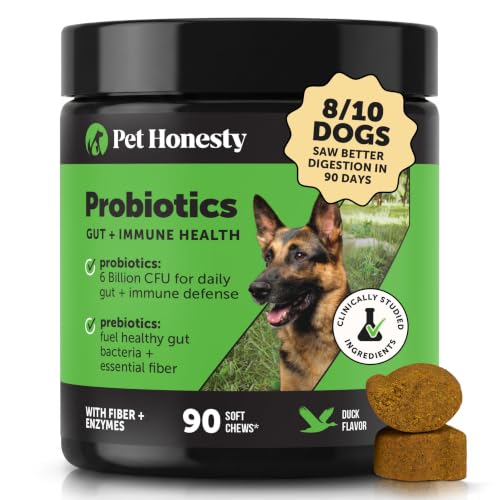
The label directions read: “Give 1 chew daily per 25 lbs of weight. Best when given just before meal time. Check with your veterinarian before giving to puppies under 6 months.” For a puppy, the vet check comes first, and the rest of your dog's diet is covered in our puppy feeding guide.
The flavor is natural duck flavor, on a base of oat flour, brewer's yeast, pumpkin, and sweet potato. The listing describes each serving as a 6 billion CFU probiotic blend paired with prebiotic fiber and “a full 7-enzyme digestive complex.” The ingredient list names Aspergillus oryzae, Aspergillus niger, and Trichoderma reesei fermentation extracts, plus papaya and pineapple stem.

Bark&Spark sets its serving by weight: “Up to 20 lbs. - 1 chew, 21 to 40 lbs. - 2 chews, 41 to 80 lbs. - 3 chews, 81 lbs. and over - 4 chews.” Its listing adds: “Strictly follow recommended servings. Exceeding daily dosage may lead to diarrhea and upset stomach.” Weigh your dog first, then read the chart.
The listing gives the flavor as natural chicken and says the chews are made in the USA. The listing's allergen line reads “Beef Free, Dairy Free, Gluten Free, Non-GMO, Soy Free.”
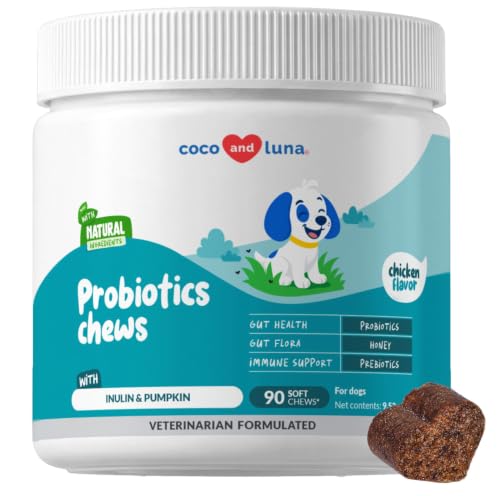
Each container holds 90 soft chews. The listing says the supplements are veterinarian formulated and free from “Palm Oil, Corn, Derivatives, Synthetic Colors, or Artificial Flavors,” and that they are made in the USA in FDA-registered facilities that are NSF and GMP-certified. The directions field on the listing reads “ALL LIFE STAGES,” so ask your vet or read the container for how many chews to give.
For food that suits a sensitive gut, see our guide to the best food for dogs with sensitive stomachs.
Cornell says: “Labels should include an expiration date, the exact species, the number of microorganisms in the product and a guarantee for the number of live organisms.” Use that as a checklist, and hold the product up against it before you buy. Cornell adds that probiotics are measured in colony forming units, or CFUs.
Some probiotics include prebiotics or vitamins for added health benefits. We always check the label to confirm these are dog-safe and beneficial to our German Shepherds' overall health.
Probiotics are one kind of supplement. Our guide to vitamins for German Shepherds covers multivitamins.
Cornell says: “Most dogs willingly eat probiotics added to their food.” Picky eaters are a separate question, and Cornell says that if a dog is pickier, “a capsule form can be easily disguised in a treat.” Powder, chewable tablets, and soft chews are all on the list above. For a treat to hide a capsule in, our guide to German Shepherd favorite treats lists options.
For pets going through an elimination diet trial, which the article describes as a strict diet that slowly reintroduces foods to determine a pet's allergies, Dr. Gould recommends looking at a probiotic's label to make sure there is no flavoring. She says many probiotic products have “animal protein flavoring or just not have good quality control during product manufacturing which can result in contamination,” and that this “can definitely confound the effects of your food trial.” Native Pet lists beef broth, FortiFlora lists liver flavor, Proviable lists natural flavor, TummyWorks lists natural chicken flavoring, and Pet Honesty lists natural duck flavor.
Cornell says: “Severely immunocompromised dogs should only be given probiotics with caution and under veterinary supervision.” Cornell gives the reason as the dog's immune system possibly not being able to handle the bacterial load.
If a German Shepherd has chronic or severe vomiting, diarrhea, or changes in appetite, the Texas A&M article says to take the dog to a veterinarian to discuss the best solution. If you're in Arizona and need tailored advice, a nearby vet in the Phoenix area can help you gauge strains and dosing. Just keep an eye on how your dog reacts and consult with your vet if you're unsure.
Leave a comment