
Your Purchase Helps
shelter pets in need
Each order helps pets in need
shelter pets in need
Each order helps pets in need

Pick a crate your German Shepherd can stand up and turn around in. The Humane World for Animals says crate training takes advantage of a dog's natural instinct to look for a comfortable, quiet, safe place when things get loud or overwhelming. Most gear lists are about toys and treats, and a crate is the item that gives the dog a place to rest.
Size is the first decision. German Shepherds need ample space, and the sizing guide behind that link says a crate at least 42 inches long works, with 48 inches even better. The AKC lists adult males at 65 to 90 pounds and females at 50 to 70 pounds. The 48-inch listing from MidWest names German Shepherds, so the seven crates below are 42 and 48 inch models, and each entry sticks to what its own listing says.
This table shows the size, doors, and main features each listing gives. Check the price and stock on the listing, because both change.
| Crate | Size on the listing | Doors and features |
|---|---|---|
| New World 48-inch single door | 48.5 x 30.25 x 32 in, for dogs of 90 to 110 lbs | One door, slide-bolt latch, leak-proof tray, no divider panel |
| MidWest 48-inch double door iCrate | 48.5 x 30.25 x 32 in, for dogs of 90 to 110 lbs | Two doors, slide-bolt latches, divider panel, leak-proof tray |
| MidWest 42-inch single door iCrate | 42.5 x 28.5 x 30.5 in, for dogs of 71 to 90 lbs | One door, divider panel, leak-proof tray |
| LEMBERI 48-inch heavy duty | 48 in, weighs 81.8 lbs | Front door and top door, dual locks, wheels with two brakes |
| BOLDBONE 48-inch heavy duty | 48 in | Double doors, double slide-bolt latches, wheels with brakes |
| Amazon Basics 48-inch double door | 48 x 30 x 32.5 in, for dogs under 46 x 28.5 in | Front and side doors, divider panel, folds flat, top handle |
| New World 42-inch double door | 42.88 x 28.75 x 30.38 in, for dogs of 71 to 90 lbs | Front and side doors, slide-bolt latches, no divider panel |
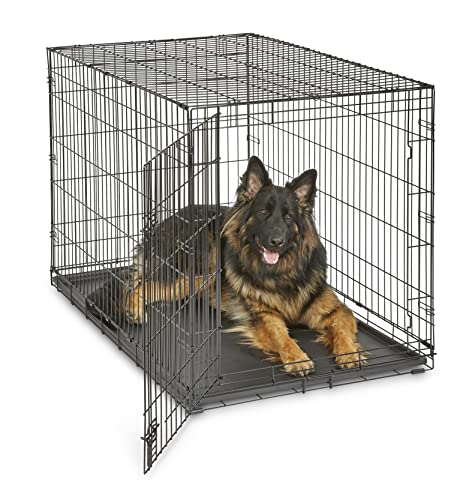
The listing gives 48.5 by 30.25 by 32 inches and says it is for dogs of 90 to 110 pounds, naming German Shepherds, Collies, and Huskies. The listing says that a divider panel is not included, so you pick the size for the adult dog, and that dogs near 110 pounds should look at the maker's 54-inch model.
It has one door with a slide-bolt latch and what the listing calls a Paw Block, plus rounded corner clips. The tray is leak-proof, the feet are rubber, there is a carry handle, and assembly needs no tools. The listing says the open wire design gives the dog visibility and ventilation.

This is the same 48.5 by 30.25 by 32 inch size and the same 90 to 110 pound range as the crate above, and the listing names German Shepherds as well. The difference is a second door and a divider panel. The listing says the divider lets the crate grow with the dog, from puppy kennel to full-size crate.
Both doors close with slide-bolt latches. The listing also gives a leak-proof tray, rubber feet, a carry handle, and tool-free assembly. It says dogs near 110 pounds should look at the 54-inch model.

The listing measures this crate at 42.5 by 28.5 by 30.5 inches and says it fits dogs of 71 to 90 pounds. The breeds it names are Australian Shepherds, Boxers, and Golden Retrievers, and it does not name German Shepherds. The AKC lists adult male German Shepherds up to 90 pounds, so a male near the top of that range sits at the top of this crate's range, and the listing itself says dogs near 90 pounds should look at its 48-inch model.
It has one door, a divider panel, a slide-bolt latch, a leak-proof tray, rubber feet, and a carry handle.

This is a steel crate that the listing says weighs 81.8 pounds. It has 20-gauge steel panels, 0.8-inch steel tubes, and welded joints, and the listing calls it escape-proof and chew-proof. The front door has a low threshold, and a second door in the top lets you reach the dog without opening the front. Dual locks and safety buckles hold the doors shut.
The floor grate has a listed load capacity of 500 pounds, with a slide-out plastic tray under it. Four wheels and ten screw bolts finish the assembly, and the listing says the rest arrives pre-assembled. The wheels swivel and two have brakes. The listing gives a one-year warranty, and it does not list outer dimensions in its text, so check the size chart there.

The listing calls this 48-inch crate indestructible and escape-proof, with a 20-gauge steel frame, 0.5-inch steel tubes, and double slide-bolt latches. The coating is described as non-toxic hammer-tone that resists rust. Both doors are wide with low thresholds, and the listing gives a removable tray and a leak-proof plastic pan.
Most of the crate arrives pre-assembled, and the listing says one person can set it up in 10 minutes. It rolls on swivel casters with brakes. The listing gives a one-year warranty and does not list outer dimensions in its text, so check the size chart there before you order.

The listing gives 48 by 30 by 32.5 inches and says the crate fits pets under 46 by 28.5 inches, with a Bernese, Labrador, Rottweiler, or Great Dane as examples. It is metal wire with a front door and a side door, a divider panel, and a manual door lock. The listing says it folds flat for transport or storage and has a top handle for carrying.
The tray is removable, and a metal hook keeps it from sliding out. The listing says to lock the hook every time you reinstall the tray. It also gives a sizing rule: measure the dog from nose to base of tail and from the top of the head to the floor, then add 4 inches to each number.

The listing gives 42.88 by 28.75 by 30.38 inches for dogs of 71 to 90 pounds, and it names Australian Shepherds, Boxers, and Golden Retrievers rather than German Shepherds. It says dogs near 90 pounds should look at the 48-inch model. A divider panel is not included.
The listing says the front and side doors give flexible placement options and easier access. It also gives slide-bolt latches with the Paw Block, a leak-proof tray, rubber feet, a carry handle, and tool-free assembly.
Both the AKC and the Humane World for Animals say the crate should be large enough for the dog to stand up and turn around in. The AKC adds that the dog should be able to lie down comfortably. Compare your dog's measurements with the size on each listing, and read the listing's own note on which dogs it fits.

A German Shepherd puppy grows into a big dog, so the AKC suggests buying a crate sized for the adult dog with a divider that can be moved as the puppy grows. The AKC gives the reason: in a crate that is too big, a puppy can eliminate in one end and sleep in the other. The Humane World for Animals also says to choose a size that fits the adult dog, and it says a local animal shelter may rent crates, so you can trade up until the dog is full grown. Three of the crates above have a divider panel in the listing: the MidWest 48-inch double door, the MidWest 42-inch single door, and the Amazon Basics 48-inch double door.
Puppies under 6 months old should not stay in a crate for more than three or four hours at a time, according to the Humane World for Animals. They cannot control their bladder or bowels for longer.
The Humane World for Animals lists three crate types: plastic crates often called flight kennels, fabric crates on a collapsible frame, and collapsible metal pens. The AKC quotes dog trainer Rachel Lane, who says some dogs prefer a wire crate so they can see the room, while others settle better in a darker, den-like crate with a removable cover. All seven crates above are metal.
The steel crates with wheels are marketed for dogs that try to escape, and two of the listings say the crates are for high-anxiety dogs. The Humane World for Animals says that using a crate as a remedy for separation anxiety will not solve the problem, and that a dog may get hurt trying to escape. The AKC says dogs with separation anxiety often panic in a crate, and it suggests a gated, puppy-proofed area and a professional trainer or behaviorist instead.
The Humane World for Animals suggests starting with the crate in a room where the family spends time, with a soft blanket or bed inside and the door propped open so the dog can look it over. It also says the crate should always hold a comfortable bed, with the door left open when you are home. The AKC suggests waiting on soft bedding until the dog stops having accidents or shredding fabric. For the bed a German Shepherd uses outside the crate, see our guide to the best dog beds for German Shepherds.

The AKC says to place the crate in a fairly quiet area, because a dog cannot be expected to relax with a lot of commotion nearby. Crates also come on trips: the Humane World for Animals calls a crate a safe way to transport a dog in a car, and our guide to pet friendly vacations has ideas for traveling with our furry friends.
The Humane World for Animals says crate training can take days or weeks, and that every step should link the crate with something pleasant. Its steps run from dropping treats near the door, to feeding meals in the crate, to closing the door for short stretches while you sit close by. On the AKC page, Lane says to toss a treat into the crate whenever the dog approaches it, and to give a food-stuffed chew toy every time the dog goes in. Our guide to chew bones for German Shepherds has options for chewing outside the crate.
Both groups say a crate is never a punishment. The AKC page says to meet the dog's potty and exercise needs before crating, and to crate a dog when it is already calm or sleepy. The Humane World for Animals says a dog crated all day and night does not get enough exercise or human interaction and can become depressed or anxious. If the dog is wound up before crate time, our guide on how to calm down a German Shepherd covers settle training, and our best harness for German Shepherds guide covers the walking gear for the exercise that comes first.
For safety, the AKC page says to take the dog's collar off whenever the dog is in the crate.
Both the AKC and the Humane World for Animals say the dog should be able to stand up and turn around in the crate, and the AKC adds that the dog should be able to lie down comfortably. The sizing guide linked above recommends at least 42 inches long and says 48 inches is better, and MidWest names German Shepherds on its 48-inch listing. Adult German Shepherds run 50 to 90 pounds according to the AKC.
The AKC says to buy a crate sized for the adult dog, with a divider so it can grow with the puppy.
The Humane World for Animals says puppies under 6 months should not be crated more than three or four hours at a time. For all ages, it says a dog crated all day and night can become depressed or anxious, and the AKC page, quoting Lane, says never to crate a dog longer than the dog is comfortable or can hold its bladder.
Not by itself. The Humane World for Animals says a crate will not solve separation anxiety and that the dog can be injured trying to get out. The AKC suggests a puppy-proofed safe area and help from a professional trainer or animal behaviorist.
No. The AKC says to take the collar off whenever the dog is in the crate, for safety.
READ NEXT: Balls for German Shepherds: Top Picks for Playful Pups
Leave a comment