
Your Purchase Helps
shelter pets in need
Each order helps pets in need
shelter pets in need
Each order helps pets in need

The nine cute birds in these pictures are a hummingbird, a northern saw-whet owl, a black-capped chickadee, an eastern bluebird, a yellow warbler, an Atlantic puffin, a great spotted woodpecker, a ruby-crowned kinglet, and a dark-eyed junco. All nine are wild birds.

This hummingbird hangs in the air beside a pink flower with its wings blurred. Audubon says hummingbirds are one of the few animals that can hover, and that they flap their wings faster than any other bird, at up to 70 beats per second. That adds up to more than 4,000 wingbeats per minute.
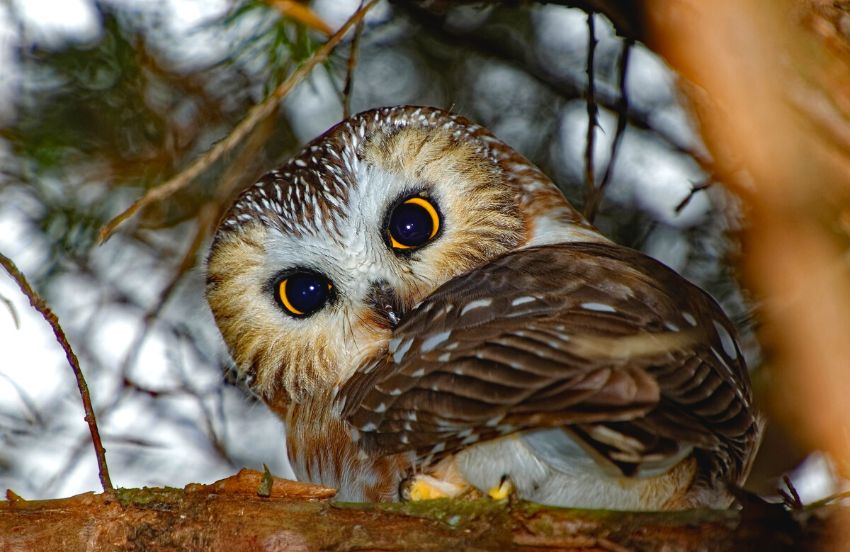
Audubon describes the northern saw-whet owl as a very small owl with no ear tufts. It says the bird was named for a song that reminded settlers of a whetstone sharpening a saw, while the Cornell Lab of Ornithology says it is not agreed which of the owl's several calls gave rise to the name.
Audubon says the owl hunts almost entirely at night, mostly for small rodents, and that “avoiding notice is a task at which this owl often succeeds.” It also says the owl will use artificial nest boxes.

This black-capped chickadee holds a seed in its beak on a conifer twig. Audubon gives the call as “a buzzy chick-a-dee-dee-dee,” and the Cornell Lab says the more dee notes in the call, the higher the threat level.
Audubon puts the bird at 5 to 6 inches long and 0.3 to 0.5 ounce in weight. Among the easiest birds to bring to a feeder with suet, sunflower, or peanuts, the chickadee is a regular visitor, Cornell says.

Two eastern bluebirds share a mossy branch, and the grayer one has its beak open. Audubon says the male is bright blue above, reddish brown on the throat and chest, and white on the belly, and that females are paler and duller.
Audubon also says the species declined significantly in many areas because of habitat loss and the loss of nesting sites, and that in recent decades the number has been increasing again, “undoubtedly helped by birdhouses in many areas.” Read more about choosing a bird gift for a bird lover.
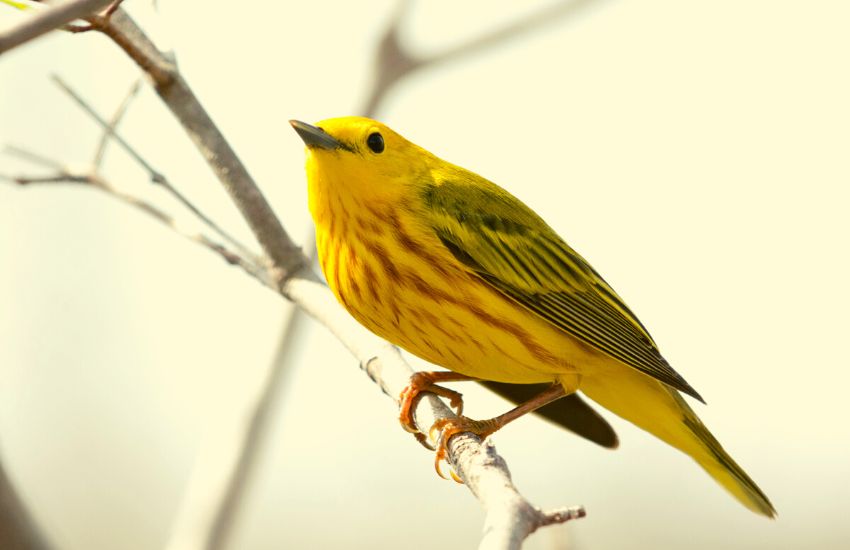
Few of North America's more than 50 warbler species combine brilliant color and easy viewing quite like the yellow warbler, the Cornell Lab says. The female and immature birds lack the male's rich chestnut streaking.
The yellow warbler nests over most of Canada and the U.S. and spends the rest of the year anywhere from southern California down to northwestern Brazil, according to Cornell. It eats mostly insects, so it does not come to backyard feeders. For its song, Cornell suggests listening for a tumbling series of whistles that sounds like “sweet sweet sweet I'm so sweet.”

Three Atlantic puffins stand on a grassy slope above the water. In winter the bill is somewhat smaller and less colorful after the outer plates are shed, Audubon says. Cornell says puffins breed in burrows on islands in the North Atlantic and winter at sea, and that puffin chicks are known as “pufflings.”
Audubon says the puffin forages while swimming underwater and can dive to about 200 feet. It also says its project to bring puffins back to former nesting islands off Maine, started in the 1970s, has been a major success, while the southernmost colonies breed poorly in warm-water years, and Audubon notes those years are getting more common.

The RSPB, a UK charity, describes the great spotted woodpecker as blackbird-sized and striking black and white. It says a male carries a bright red patch at the back of the head, and young birds show red on the crown. The RSPB adds that the bird's presence is often announced by its loud call or its spring drumming display, a rapid burst of drumming that lasts about a second.
NPR's report from July 14, 2022 covers a study in Current Biology in which Sam Van Wassenbergh of the University of Antwerp and his team filmed woodpeckers at four zoos in Europe. The report says a woodpecker's brain is too small for pecking to cause a concussion: the brain is about 700 times smaller than a human brain, and Van Wassenbergh says even the hardest hits the team observed “are not expected to cause any concussion.” The report adds that woodpeckers close their eyes at the moment of impact.

This ruby-crowned kinglet shows a small red patch on its crown. The male's ruby crown patch is raised only in excitement, and Audubon describes the song as an excited musical chattering. Audubon compares it with the golden-crowned kinglet, a different species, and says the ruby-crowned does more hovering and flycatching and less hanging on twigs.
Kinglets flick their wings nearly constantly, the Cornell Lab says.

In much of the eastern U.S., juncos arrive when winter starts and head north again in spring, while other juncos stay in one place all year, according to the Cornell Lab.
The dark-eyed junco is a variable bird, Audubon says. It says the form called the Slate-colored Junco is the only one usually seen in the East, while the Oregon Junco is widespread in the West. Audubon also says the junco finds most of its food by hopping and running along the ground, and that at a feeder it usually works the ground beneath the tray.
Cornell advises putting up an eastern bluebird nest box well before breeding season and attaching a guard to keep predators from raiding eggs and young. Read more about putting out nesting materials for backyard birds.
Read more about how to prevent birds from flying into your windows.
Our rescue shirts collection has animal rescue t-shirts and apparel for dogs and cats. Pet parents who travel with a dog can read more about animal rescue vacations, a page of dog-friendly vacation ideas. For volunteer trips, read more about volunteer vacation ideas for animal lovers.
It depends on the bird. Audubon lists open country with scattered trees, such as farms and roadsides, as eastern bluebird habitat, and forests, conifers, and groves for the northern saw-whet owl. The Cornell Lab says to listen for yellow warblers in wet woods, thickets, or streamsides. The RSPB says great spotted woodpeckers live across most of the UK, in bigger woods as well as gardens and parks.
Yes, if the feeder is kept clean, Audubon says. It says backyard feeders are good for birds as long as you follow some simple guidelines. Its feeder article says it is not enough to put out a feeder and fill it regularly: the feeder has to be cleaned, or the birds that visit risk getting sick. It names house finch eye disease, salmonellosis, aspergillosis, avian pox, and avian flu among the diseases birds can spread through feeders.
Audubon says the National Wildlife Health Center recommends cleaning feeders with a solution of nine parts water to one part bleach and drying the feeder before it goes back up. Project FeederWatch, a joint effort of the Cornell Lab and Birds Canada, recommends cleaning seed feeders every two weeks or so, and Audubon says to clean twice as often if you suspect disease. Under the feeder, Audubon says to rake or shovel up droppings and hulls, especially moldy, wet, or spoiled ones, and that having several feeders can help prevent disease. If you see a sick bird, Audubon says not to pick it up or try to treat it, and to contact a local wildlife rehabilitator.
It depends on the bird. The Cornell Lab says chickadees are one of the easiest birds to attract to feeders and that a junco often comes to them. It says the yellow warbler eats mostly insects, so it does not come to backyard feeders.
Leave a comment