
Your Purchase Helps
shelter pets in need
Each order helps pets in need
shelter pets in need
Each order helps pets in need

A good rat cage is large, has a solid floor, and has bars close enough that a rat cannot poke its head through. Those are the points for a rat home from the RSPCA, a UK animal welfare charity, and they decide the order of the seven cages below. The two Critter Nation cages come first because their listings describe plastic pan floors. The three cages near the end describe wire grate floors, and the RSPCA says wire floors can lead to foot problems.
Most of these cages are sold for several kinds of small animals, so the listings name rats next to ferrets, chinchillas, or hamsters. Rats do best in company, and the RSPCA recommends a pair or a trio, so the cage you pick has to hold at least two rats.
The table shows what each listing gives for size, bar spacing, and floor. The picks after it cover everything else the listing says.
| Cage | Size and bar spacing | Floor |
|---|---|---|
| Critter Nation Double Unit | 36 x 24 x 63; 1/2 inch horizontal wire | Plastic pan floors |
| Critter Nation Single Unit | 36 x 25 x 38.5; 1/2 inch horizontal wire | Plastic pan floor |
| Mcage Mansion 23" | 23 x 14 x 27; 3/8 inch | Not described |
| Kaytee Rat Home | 25.5 x 12.5 x 14; 1/2 inch | Not described |
| Mcage 3-Level | 24 x 16 x 24; 1/2 inch wire, 3/8 inch cross bars | Metal grated floor |
| Yaheetech 52" Metal Rat Cage | 52 inch in the name, no other size; spacing not stated | Metal grate over the tray |
| Yaheetech 69-Inch Animal Cage | 69 inch in the name, no other size; 0.4 inch | Bottom grate over the tray |
The RSPCA says a rat cage should be as large as possible. It gives no minimum measurement, so the table is the way to compare. Of the five cages whose listings give inches, the two Critter Nation cages are the largest in every direction.
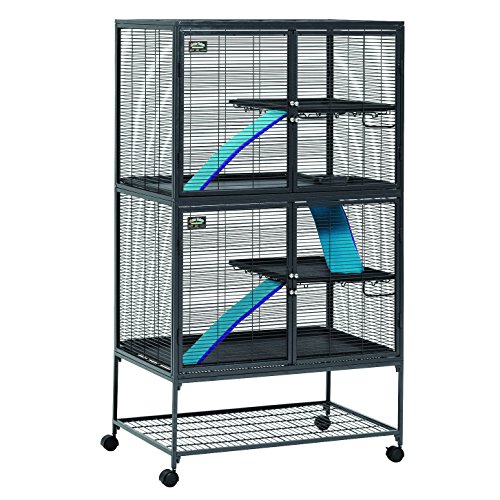
This is the only cage here with two full levels. The listing says it comes with two removable base pans, three textured ramps with covers, and two full-width resting shelves, and that it is height-adjustable. The full-width double doors open the front, and a swing-up locking ramp lets you separate pets or close off an area during cleaning and feeding. The listing names rats among the animals the wire spacing safely contains.
It matches the RSPCA's solid floor point as the listing describes it, with plastic pan floors on both levels. The RSPCA also asks for places to climb and hide at different heights, and two levels give room for that.
What the listing highlights
Check before you buy
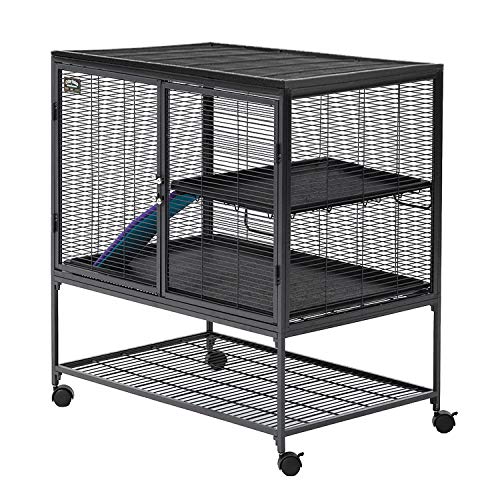
The Single Unit has a main level and an upper shelf, the same wire as the Double Unit, and a plastic pan floor. The listing says it comes with a removable base pan, a textured ramp with a cover, and a full-width resting shelf. It lists rats among the animals the wire spacing safely contains, and it says the cage is compatible with MidWest's Add-On Unit for more room.
It meets the RSPCA's solid floor point as listed. With one shelf instead of a second level, it gives a pair or trio fewer heights to use than the Double Unit.
What the listing highlights
Check before you buy
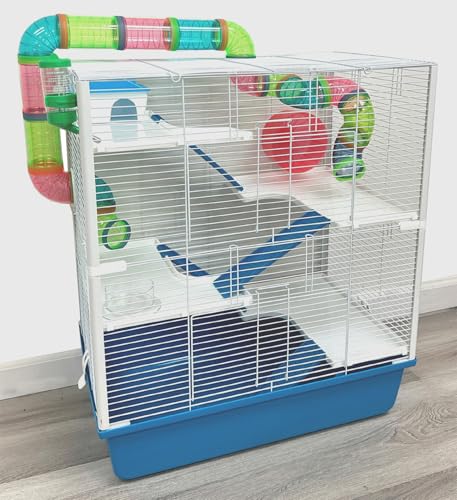
The Mansion's listing names hamsters first, then gerbils, mice, and rats. The listing says it has five levels, four solid platforms, four solid anti-slip ramps, two large front doors, and a deep base for extra bedding. It comes with a food bowl, a water bottle, a hide house, a running wheel, and a tube tunnel.
The RSPCA lists tunnels, ladders, and shelters among the things that encourage rats to explore and exercise, and this cage comes with a tube tunnel and step ramps. The listing does not say what the floor is made of, so check the product page for that before you buy. Texas A&M's Dr. Sharman Hoppes says rats may get obese in captivity and names exercise wheels, exercise balls, or a safe rodent-proof room for exercise. This cage comes with a running wheel.
What the listing highlights
Check before you buy

The product name is "Kaytee My First Home Habitat for Pet Rats," and the listing says the wire spacing is "Ideal for rats." It lists chew-proof locks and wire, a deep base that keeps bedding and litter from spilling, multiple levels, and solid plastic shelves and ramps that are easy to clean.
It has the lowest height in the table at 14 inches. The RSPCA says rats need space to "stretch up on their hind legs, climb and explore," and that the cage should be as large as possible. The listing does not say what the floor is made of.
What the listing highlights
Check before you buy

This is an all-metal cage with three levels, wire shelves, and ladders. The listing says it has two front doors with locking clips, a pull-out washable tray, and a collapsible design with two carrier handles. It names rats among the animals it suits, along with chinchillas, ferrets, guinea pigs, rabbits, and hamsters.
The listing describes a metal grated floor, and the RSPCA says rats need "a solid floor, not wire mesh, as wire floors can lead to foot problems." On that point this cage falls short as listed.
What the listing highlights
Check before you buy

The product name calls this a six-level metal rat cage with three front doors, a feeder, and wheels, and the listing also names ferrets, chinchillas, rabbits, and squirrels. It says the frame is powder-coated steel with smooth seams and rounded corners, that the ramps are corrugated so pets do not slip, and that the four casters make it easy to move.
The listing says a metal grate separates pets from the litter tray, which is a grate instead of a solid floor, so it falls short of the RSPCA's solid floor point as listed. The listing text gives no bar spacing, and the RSPCA says the spacing must be small enough that a rat cannot poke its head through, so find the spacing on the product page before you buy.
What the listing highlights
Check before you buy

The listing calls this an ultralarge bird cage and says it also suits small animals such as sugar gliders, rats, and squirrels. It has two front doors secured with crescent locks, ten smaller side and front doors, and a detachable stand on four swivel casters. The frame is metal with an antirust hammertone finish, and the product name lists three levels with cross shelves and ladders.
It is the only cage here whose listing text talks about birds first. The listing says a bottom grate separates pets from their droppings, so it falls short of the RSPCA's solid floor point as listed.
What the listing highlights
Check before you buy
Need supplies for rodent pet grooming sessions? Here are our top picks for hamster grooming supplies, written for hamsters.
The RSPCA says rats "are active and need space to run, stretch up on their hind legs, climb and explore," and that the cage should be "as large as possible." The PDSA gives small pets the same advice: "Aim to give your pets as much space as you can." Neither gives a minimum size, so use the table to compare cages by their listing inches and pick the largest one that fits the room. Rat cage requirements are covered at more length by Animal Llama.
The RSPCA says rats are good at squeezing through gaps, and that "the bar spacing should be small enough to stop your rats from being able to poke their head through" because "once the head is through the whole body will follow." It gives no measurement. The listings here give 3/8 inch, 1/2 inch, or 0.4 inch for the cages that state a spacing. The RSPCA also says to check the cage regularly, "as rats can chew through some materials such as wood and plastic."
The RSPCA says the cage should "have a solid floor, not wire mesh, as wire floors can lead to foot problems." Check what each listing says about the floor. The Critter Nation cages list plastic pan floors, the Mcage Mansion and Kaytee listings do not describe the floor, and the other three describe a metal grate.
The RSPCA wants a cage that offers "places to hide, climb and investigate at different heights," with walls, platforms, tunnels, ropes, hammocks, ladders, and shelters, though "the enrichment shouldn't take over the entire cage space." It also says "the number of available shelters should exceed the number of rats by one." For two rats, that means three shelters. Cloth beds and hammocks are items rats are known to chew, and About Pet Rats describes many rats treating them as something to chew. PetMD says rats need a lot of mental stimulation, and its enrichment guide shows how to make sure that a rat's environment is stimulating. Our page on tubes and tunnels for hamsters shows tunnel options.
The RSPCA says to clean the cage out once a week, spot-clean through the week, and leave a handful of unsoiled nesting material behind so familiar smells stay. Texas A&M's Dr. Hoppes says to clean a rodent cage one to two times a week "to keep ammonia levels down," and that a clean cage "will also help decrease the incidence of respiratory disease." Our page on whether pet rats attract other rodents covers how food and cleaning habits affect a rat household.
The RSPCA also says to keep the cage in one place, out of direct sunlight, and in a part of the house that does not get very hot or cold, and not in a conservatory, garage, or shed. It gives an ideal temperature for rats of 19 to 23 degrees Celsius.
The RSPCA says rats "should never be kept alone" and recommends "adopting a pair, or a trio, of bonded rats in same-sex groupings, or spayed and neutered if they're different sexes." Texas A&M's Dr. Hoppes recommends two rats at a time. Lafeber also says rats do best in same-sex pairs or groups. Size the cage for the number of rats you plan to keep.
Also planning on adopting a hamster? Check out the best hamster cages here!
The RSPCA lists a large cage, a solid floor, bars close enough that a head cannot get through, places to hide and climb at different heights, and a secure design with no projections that could harm the rats. The Buying Guide above covers each point.
The RSPCA says the cage should be as large as possible, and Texas A&M says all pet rodents need "a large enough cage." The PDSA says to give small pets as much space as you can. Since rats should live in pairs or trios, the cage has to suit at least two.
The RSPCA recommends a pair or a trio of bonded rats in same-sex groups, and Texas A&M recommends getting two rats at a time. Both say rats need company.
The RSPCA says a rat cage should have a solid floor, not wire mesh, because wire floors can lead to foot problems. In the table, three cages describe a metal grate floor.
The RSPCA says once a week, with spot-cleaning in between. Texas A&M says one to two times a week.
A Lafeber page on pet rat behavior describes the natural behaviors rats show. The RSPCA says the cage should be "as large as possible, with lots of space so that your rats can perform all natural behaviours." Our page on rats and tickling covers one study of rats at play with people. Dr. Hoppes of Texas A&M says "Rats may get obese in captivity, so you should have exercise wheels, exercise balls, or a safe rodent-proof room for them to play in and get enough exercise."
READ NEXT: Best Hamster Brushes: Top Picks for Your Pet's Grooming Needs
Comments
Leave a comment