
Your Purchase Helps
shelter pets in need
Each order helps pets in need
shelter pets in need
Each order helps pets in need

Cats are chronically under-hydrated, and most owners don't realize it. In the wild, cats get the bulk of their moisture from prey. Domestic cats eating dry cat food are working with a fraction of that water intake, which puts extra pressure on their kidneys over time. Urinary tract issues and kidney disease are among the most common health problems in cats, and dehydration is a major contributing factor.
Here's the thing about cats and water: they're hardwired to distrust still water. Stagnant puddles in nature can carry bacteria, so cats instinctively prefer moving water. That's why your cat ignores their water bowl but sprints to the bathroom sink the second you turn on the faucet. A water fountain mimics that running water, and for a lot of cats, it's the difference between barely sipping and actually drinking enough throughout the day.
Dehydration in cats is sneaky because the signs are subtle until things get serious. Lethargy, dry gums, loss of skin elasticity, decreased appetite. By the time you notice, your cat has probably been under-hydrated for weeks. A fountain won't solve every health issue, but making fresh, flowing water available around the clock is one of the simplest things you can do to support your cat's kidney and urinary health long-term.
I looked at the most popular cat water fountains on Amazon, focusing on stainless steel options (more hygienic than plastic), pump noise levels, and how easy they are to clean. These are the six best options for keeping your cat properly hydrated in 2026.
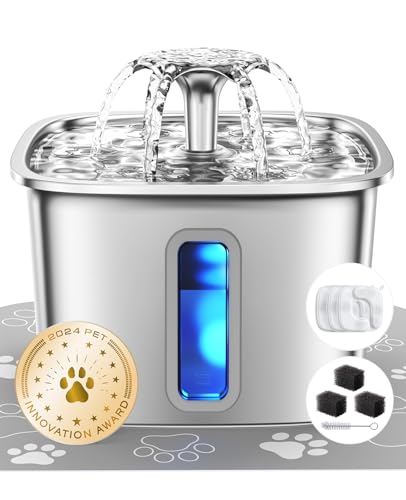
Veken's 108oz stainless steel fountain is a beast in terms of capacity. At 3.2 liters, it holds enough water to last most single-cat households about a week without a refill. The transparent water tank makes it easy to check levels at a glance, so you're not constantly lifting the lid to see how much is left.
The pump runs quietly enough that you won't notice it from across the room. It circulates water through a triple filtration system (cotton, activated carbon, and ion exchange resin) that keeps things fresh between cleanings. The stainless steel top is hygienic and won't develop the slimy biofilm that plastic fountains are notorious for.
The one thing to watch is the water level sensor. When the tank gets low, the pump can start making a gurgling noise that some cats find alarming. Keep it topped up and you won't have that problem. The large capacity actually helps here since you're refilling less often than with smaller fountains.
Pros
Cons

This is Veken's budget-friendly plastic option, and it consistently ranks among the most popular cat fountains on Amazon. The BPA-free construction keeps things safe, and the 95oz capacity is plenty for one or two cats. Five different water flow settings let you adjust the stream from a gentle bubble to a free-falling spout, so you can figure out which style your cat actually prefers.
Setup takes about two minutes. Fill the reservoir, drop in the filter, plug it in, done. The LED light on the front glows when water is running and turns off when the reservoir needs a refill. It's a small detail, but helpful if the fountain is tucked in a corner where you can't easily see the water level.
Plastic fountains will always be more prone to bacterial buildup than stainless steel, so you'll need to scrub this one thoroughly every week or two. The filters should be swapped every 2 to 4 weeks depending on how hard your water is. At this price point, though, it's hard to complain. It does exactly what it needs to do.
Pros
Cons

Think of this as the middle ground between Veken's large 108oz model and their budget plastic fountain. You get the same stainless steel construction (which cats tend to prefer over plastic anyway), but in a slightly smaller, more compact form factor. At 95oz it still holds nearly three liters, so you're not refilling it every other day.
The water flow on this one is smooth and consistent. It produces a gentle stream that most cats find inviting without being so aggressive that it splashes water onto the floor. The filtration system uses the same triple-layer filters as the rest of the Veken lineup, and they're widely available online, which is a real plus. Nothing worse than a fountain you love but can't find filters for.
If you have a cat that likes to bat at the water stream or stick their face right under the flow, the stainless steel bowl is going to hold up much better than a plastic one. Plastic scratches easily, and those scratches harbor bacteria. Stainless steel stays smooth and is much easier to sanitize during your weekly cleaning routine.
Pros
Cons

This 108oz fountain pulls double duty as a water source and a subtle nightlight. The built-in LED glows through the water stream, which looks cool but also serves a practical purpose: it helps your cat find the fountain in a dark room. Cats can see in low light, sure, but the visual cue of running, illuminated water catches their attention and draws them over to drink.
Construction quality is solid. The stainless steel basin has a good weight to it, so your cat isn't going to push it across the floor during an enthusiastic drinking session. The pump is submersible and easy to disassemble for cleaning. Water circulates through an activated carbon filter that removes impurities and keeps things tasting fresh.
One thing worth mentioning: the LED is always on while the pump is running. There's no way to disable it without unplugging the fountain entirely. If the fountain is in your bedroom and the glow bothers you at night, that could be annoying. Everywhere else in the house, it's a nice feature that cats seem to genuinely respond to.
Pros
Cons

Noise is the number one reason people return cat fountains, and this one addresses that head-on. The pump operates below 30 decibels, which is basically inaudible unless you press your ear against it. If you keep a fountain in your bedroom or home office, that near-silent operation makes a real difference in your daily life.
The adjustable flow knob lets you dial the water stream from a trickle to a steady pour. Start with a gentle flow while your cat is getting used to the fountain, then increase it once they're comfortable. Some cats like a strong stream they can lap at; others prefer a soft bubble. Having the option to adjust without swapping parts is genuinely useful.
At 88oz it's slightly smaller than the 95oz and 108oz models in this list, but that's a tradeoff for the slimmer, lower-profile design. It sits closer to the ground, which older cats and kittens tend to appreciate. The stainless steel is 304 grade (food-safe), and the whole unit breaks down into a few pieces for easy handwashing.
Pros
Cons
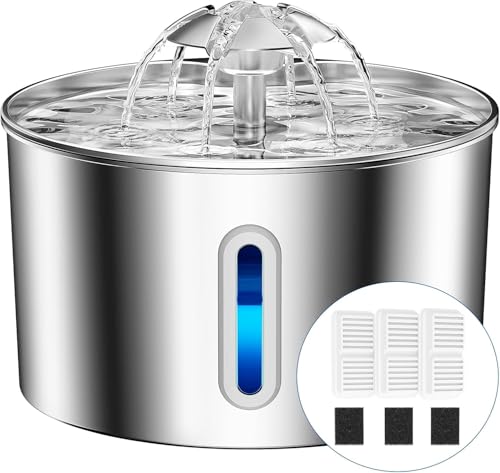
Not every cat household needs a jumbo fountain. If you have one cat in an apartment, this 74oz model gives you clean, circulating water without taking up half your kitchen floor. The footprint is compact enough to tuck next to a cabinet or against a wall, and the lower capacity means less water weight to lug around when you're cleaning it.
The design uses a gentle dome flow where water wells up from the center and cascades down the sides. Cats who don't like direct streams tend to prefer this style because they can drink from any angle around the rim. The stainless steel bowl is wide and shallow, so even flat-faced breeds like Persians can drink comfortably without getting their whiskers wet.
The tradeoff for the smaller size is obvious: you'll be refilling it more often. For a single cat, expect to top it off every 3 to 4 days. If you have two cats sharing it, that drops to every other day. The pump and filter system work exactly the same as larger models, just in a smaller package. Think of it as the studio apartment of cat fountains.
Pros
Cons
Stainless steel is the gold standard. It doesn't scratch, doesn't harbor bacteria in tiny grooves, and is dishwasher safe. Plastic is cheaper but scratches easily, and those scratches become breeding grounds for bacteria that cause feline acne (those black dots on your cat's chin). Ceramic looks nice but chips easily and is heavy. For most people, stainless steel hits the best balance of hygiene, durability, and price.
One thing to keep in mind: some cats develop chin acne specifically from drinking out of plastic bowls and fountains. If your cat has those little black specks on their chin, switching to stainless steel often clears it up within a few weeks. It's one of those small changes that can make a surprisingly big difference.
A single cat drinks about 7 to 10 ounces of water per day. A 95oz fountain gives you roughly 10 days of water for one cat before you need to refill. Multi-cat households should go bigger (108oz or more), while a single cat in a small apartment can get by with a 74oz model. Keep in mind that you should be swapping the water entirely every week regardless of how much is left, so a giant fountain doesn't mean you can ignore it for two weeks.
If you travel or work long hours, lean toward a larger capacity fountain. Running out of water isn't just inconvenient. When the reservoir gets too low, the pump starts sucking air, which can burn it out. A bigger tank gives you more margin for error.
This matters more than most people think. If the fountain is loud, you'll get annoyed and unplug it, which defeats the purpose. Some cats are also spooked by noisy pumps. The best fountains run below 40 decibels, which is quieter than a refrigerator hum. Ultra-quiet models hit 25 to 30 decibels, practically silent. Always check recent reviews for noise complaints because pump quality can vary between production batches.
Keep in mind that pumps get louder over time as mineral deposits build up on the impeller. Regular cleaning (especially soaking the pump in diluted white vinegar once a month) will keep noise levels down. If a fountain that used to be quiet starts buzzing or rattling, the pump probably just needs a good cleaning, not a replacement.
Most cat fountains use activated carbon filters that remove chlorine taste, hair, debris, and some minerals. The filters need replacing every 2 to 4 weeks depending on your water hardness and how many cats use the fountain. Before buying, check that replacement filters are easy to find and reasonably priced. A fountain with cheap proprietary filters that are always out of stock online is going to become a headache.
If you have hard water (lots of mineral deposits), you'll be replacing filters more frequently. Some owners use filtered or bottled water in their fountains to extend filter life and reduce mineral buildup on the pump. It costs a little more, but your filters and pump will last noticeably longer.
Pick a fountain that comes apart easily. You should be fully disassembling and scrubbing every component (bowl, pump, housing) at least once a week. Fountains with lots of tiny crevices or parts that don't separate are going to accumulate slime in places you can't reach. The simpler the design, the easier it is to keep clean. Some pumps are dishwasher safe, which is a huge time saver.
That pink or orange slime you sometimes see in pet fountains is called Serratia marcescens. It's a bacteria that thrives in moist environments and can cause urinary tract infections in cats if left unchecked. Scrubbing the fountain with a small bottle brush and warm soapy water every week prevents it from gaining a foothold. Don't rely on the filter alone to keep things sanitary.
Yes, and there's actual research behind it. A 2010 study in the Journal of Feline Medicine and Surgery found that cats with access to flowing water drank significantly more than cats with still bowls. Anecdotally, most cat owners report a noticeable increase in water consumption after switching to a fountain. It won't turn a cat that never drinks into a camel, but the moving water triggers their natural preference for fresh, flowing sources.
You can test this yourself pretty easily. Mark the water level on your cat's current bowl and track how much they drink over a few days. Then set up a fountain and compare. Most people notice their cat visiting the fountain much more frequently than they ever visited a static bowl.
Once a week, minimum. Drain all the water, take every piece apart, and scrub with warm soapy water. Pay special attention to the pump. Hair and mineral deposits build up inside the impeller, which makes the pump louder and less effective over time. Rinse everything thoroughly before reassembling. Swap the filter every 2 to 4 weeks. If you notice any pink or brown slime forming between cleanings, increase your cleaning frequency.
A quick tip: keep a small bottle brush near the fountain. The kind used for cleaning straws works perfectly for getting inside the pump housing and water tubes. Two minutes of scrubbing once a week prevents the kind of buildup that takes 20 minutes to remove when you've let it go too long.
They're designed to run 24/7. The pump circulates and filters the water continuously, which is actually healthier than letting it sit still. Turning the fountain off causes water to stagnate faster. The only time you should unplug it is during your weekly cleaning or if the water level drops so low that the pump starts sucking air (you'll hear a loud gurgling sound). Running the pump dry can damage it permanently.
Electricity cost is negligible. These pumps draw between 2 and 5 watts, which works out to pennies per month on your electric bill. You'd spend more money on the gas driving to buy a new pump than you would running the fountain for an entire year.
Start with the fountain turned off and filled with water, placed next to their regular water bowl. Let them investigate it for a couple of days. Then plug it in on the lowest flow setting while they're nearby (but not eating or sleeping). Keep their old bowl available as a backup so they don't feel forced. Most cats come around within a week. Some take two. If your cat is still avoiding it after two weeks, try a different flow style. Cats that hate streams sometimes love the gentle dome or bubble flow types.
Placing a few treats around the base of the fountain can also help build a positive association. Some owners dip their finger in the flowing water and let their cat lick it off as a way to show them the water is safe. Cats are cautious by nature, so patience is the key here. Forcing the issue almost always backfires.
Leave a comment