
Your Purchase Helps
shelter pets in need
Each order helps pets in need
shelter pets in need
Each order helps pets in need

These 18 sad dog books run from picture books for ages 5 to 8 to adult memoirs. Each entry gives the author, the year, the publisher, and what the story is about. The plot lines stop before the endings, and any line that touches an ending comes after a spoiler warning.
Start with the reader's age. The publishers name these ranges: The Longest Letsgoboy is for ages 5 to 8, Love That Dog for ages 8 to 12, and Letters From Wolfie for ages 10 and up. Sad, the Dog is a picture book. The rest are written for adults.
If you want a shorter cry first, watch Jimmy Stewart read his poem about his dog Beau. If you want animal books that are true accounts and not about dogs, our list of the best books about animals is a good next stop.

By Wilson Rawls
Where the Red Fern Grows is about a boy in the Oklahoma Ozarks and his two hunting dogs. Kirkus reviewed it in 1961 as a story of "a 10 year old boy and his pair of hunting dogs."
Many people first read it in school. Kirkus wrote that it "should appeal to the animal loving audience." Plan for a hard last few chapters.

Photo credit: thefirstedition.com
By David Wroblewski
The Story of Edgar Sawtelle is a retelling of Hamlet. Edgar is a boy who cannot speak, and his family raises dogs. One of them, Almondine, is described by Kirkus as "from an extremely rare breed."
Kirkus writes that Edgar "may be voiceless, but he is capable of expressing sorrow and rage" when his father suddenly dies. This is a long adult novel, and it is sad for the people as much as for the dogs.

By Garth Stein
The narrator of The Art of Racing in the Rain is a dog named Enzo. Kirkus says he observes Denny's struggles, and the story is told from the dog's point of view.
Kirkus calls the book "pointedly inspirational." It suits readers who want the dog's own point of view.

By Sharon Creech
This one is a book of poems that together tell one story. A boy named Jack writes them as dated journal entries for his teacher, Miss Stretchberry. Publishers Weekly says the author "examines the bond between a boy and his dog."
Because it is written as short poems, it reads quickly.

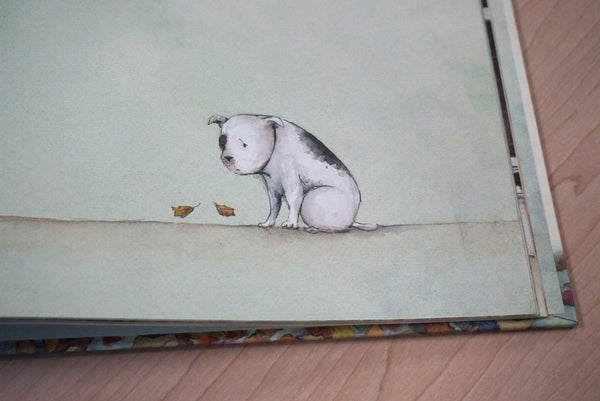
Photo credit: childrensbooksdaily.com
By Sandy Fussell, illustrated by Tull Suwannakit
The Children's Book Council describes the dog this way: "A clever little dog christens himself 'Sad' when his humans fail to give him a name."
His people move away and leave him behind. A new family arrives with a young boy. It is a gentler cry than most books on this list, and a good first one for a child.

By Fred Gipson
Old Yeller is set in Texas in the late 1860s. Travis is fourteen, and he is left in charge of the family homestead while his father drives cattle north. The dog of the title is the one who arrives to share that homestead.
It won a Newbery Honor in 1957. Plan for a hard ending.

By Lesléa Newman, illustrated by Machiyo Kodaira
This illustrated book tells the true story of Hachiko, an Akita in Japan. Each afternoon he waited at the train station for Professor Hidesaburo Ueno of the Tokyo Imperial University, who rode the train home from work. A library summary calls him "Professor Ueno's loyal Akita."
Spoiler warning: Professor Ueno died at work in 1925, and Hachiko kept coming to the station almost daily for the next nine and a half years. A bronze statue of him was unveiled at Shibuya Station in 1934, and he died in 1935.

By Nick Jans
This is a nonfiction account of a wild black wolf near Juneau, Alaska. Kirkus says the story opens in the early winter of 2003 near Mendenhall Glacier, and that the wolf "was crazy for dogs."
Kirkus calls the book "an astute, deeply respectful encounter between man and wolf." It is nonfiction, so the sadness comes from real events.


By Mark R. Levin
Rescuing Sprite is a memoir by a radio talk-show host about a rescue dog his family adopted. The library summary describes Sprite as "a beautiful, loving, and gentle animal whose deteriorating health taught the entire family a lesson in friendship, love, joy, and grief."
Readers who have lost a dog to illness will recognize the long stretch of vet visits and hope. It is the most direct grief book in this part of the list.

By Catherine Ryan Hyde
Say Goodbye for Now is set in 1959 Texas. Dr. Lucy lives on an isolated ranch where she cares for abandoned animals. A twelve-year-old white boy, Pete, becomes friends with Justin, a Black boy who has just moved to town with his father, in a community where that friendship is not welcome.
Pete finds an injured dog that Kirkus describes as "a possibly wild, probably dangerous, half-wolf hybrid" and takes it to Dr. Lucy. If you already agree that life is better with a dog, this one will confirm it.

By Lynn Hall, illustrated by Antonio Castro
Barry was a real Saint Bernard. He was born in 1800 and worked as a rescue dog at the hospice on the Great St. Bernard Pass in Switzerland. The Natural History Museum of Bern says he is "said to have helped in the rescue of 40 people."
The book is divided into four parts: Barry and Werner, Training Days, Terrible Winter, and One Last Rescue. Spoiler warning: the museum records that Barry died in 1814.


By Dan Rhodes
Timoleon Vieta Come Home is, in the catalog's words, "a free-wheelin' take on the Lassie legend." Timoleon is a mongrel living in the Italian countryside with Cockroft, a composer in exile, until a malevolent stranger known as the Bosnian comes to stay.
It is an adult novel, and it may make you miss your dog even before the sad part arrives.

By Patti Sherlock
Wolfie is "part malamute, part German shepherd, and all heart." It is 1969 and the Vietnam War is still going, so when Mark learns the army needs scout dogs, he decides to send Wolfie. His father says a smart dog could save soldiers like Mark's brother, Danny.
Penguin Random House calls it "inspired by real events" and "a heartbreaking story about sacrifice, loyalty, and the complex meanings of patriotism."
By Kate DiCamillo
This one reads like a light story for a long time. Opal is a girl who has a dog named Winn-Dixie, and Publishers Weekly says the book "percolates with heartfelt emotion and eccentric Southern color."
The sad part is Opal's absent mother. The preacher, Opal's father, tells her ten things about her, one for each year Opal has been alive. It is DiCamillo's debut novel and a 2001 Newbery Honor Book.
By Derick Wilder, illustrated by Catia Chien
A dog and his little girl go on their final walk together. Chronicle says the dog "experiences the sights, smells, and wonders of this world one last time."
Kirkus gave it a starred review and wrote that readers "will laugh and cry." It is short, so it is easy to read with a child and then read again alone.
By John Grogan
John and Jenny Grogan bring home a yellow Lab puppy named Marley, who grows into a 97-pound Labrador retriever. The book is a memoir. LitLovers describes Marley as a "bigger-than-life, bad-boy dog."
Most of the book is funny, and that is why the sad part is hard for readers who got attached to him.
By Christine Nicole Ferris
Redemption Press says Christine Ferris "unexpectedly had to part with her beloved sixteen-month-old rough collie named Lad."
The book is built around what she calls "Lad lessons" on trust, dealing with trials, learning discipline, and "the gifts of pain and loss."
By Nancy Tillman
This picture book is about pets in general, not only dogs. Kirkus describes a pastoral heaven filled with "pampered pets, ethereal angels and friendly animals of all sorts."
Spoiler warning: Kirkus describes "a joyous reunion between a boy and his dog." It is a good book to share with a child after a loss.
Ready for a dog after all these? Our guide to What Kind of Dog Should I Get covers how breed finders can help.
Plot lines come from Kirkus Reviews, Publishers Weekly, Penguin Random House, Chronicle Books, Redemption Press, the Children's Book Council listing, Open Library catalog summaries, EBSCO, and the Natural History Museum of Bern. Prices and availability on Amazon were checked on September 30, 2026.
Comments
Leave a comment